Chapter 12 · Les Fonds
Basic B (Starch-Based Batter)
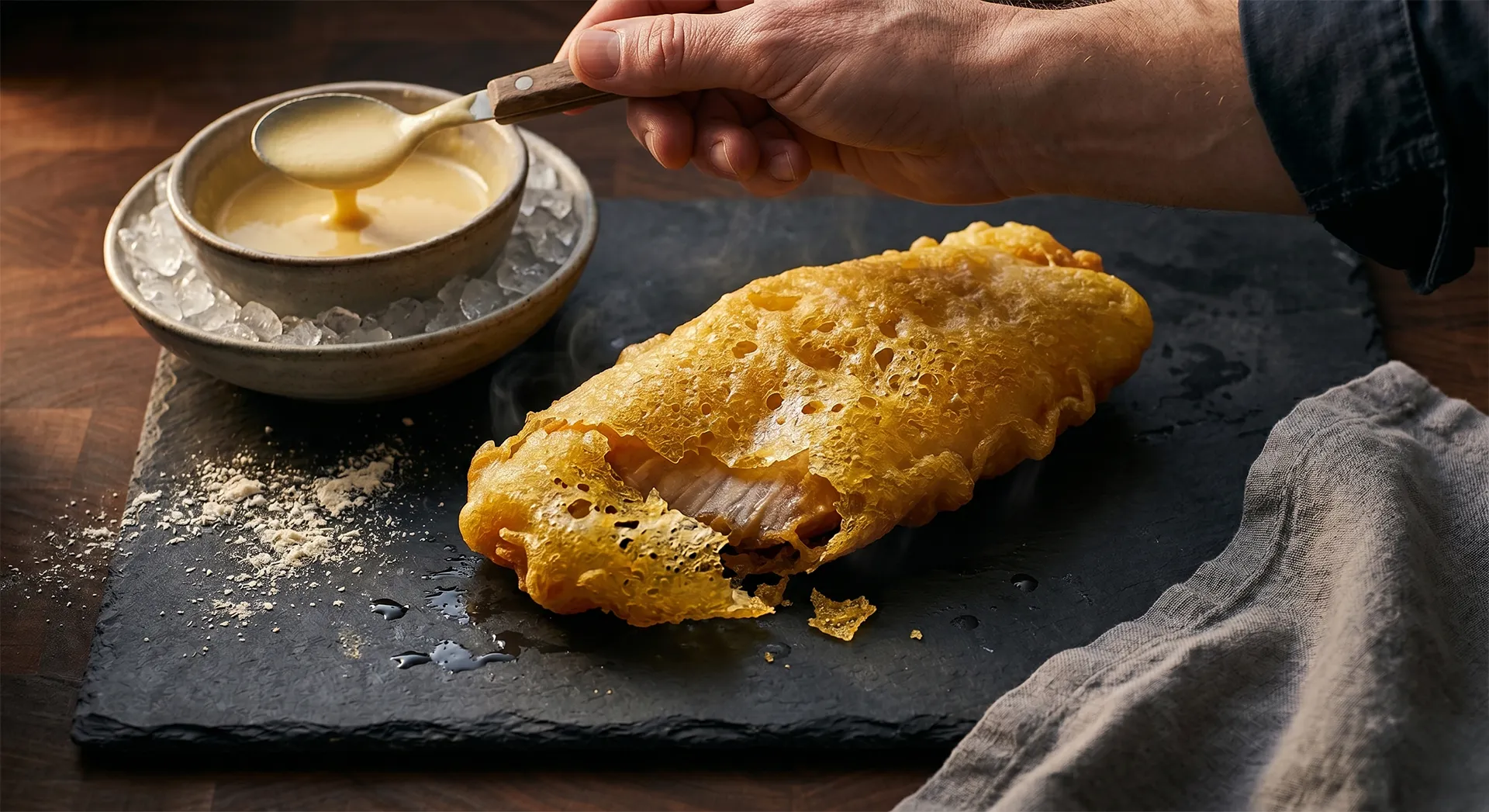
A high-performance, gluten-free coating engineered for a glass-like shatter and superior lightness through controlled starch gelatinization.
Yield: ~1.2 kg batter | Prep: 10 min | Cook: N/A | Total: 10 min
Headnote
This water-based batter leverages the specific starch-to-protein ratio found in gluten-free blends to achieve a brittle, translucent shell that stays crisp longer than traditional wheat-based versions. By incorporating mace and turmeric, we anchor the high-toned starch profile with earthy, floral depth and a vibrant golden hue — a batter that performs and presents. The mandatory dry-dredge step is not optional: without a starch bridge between the product surface and the liquid batter, adhesion fails at oil contact.
Teaching Idea: Starch Gelatinization. When starch granules are hydrated and then subjected to the violent thermal shock of frying oil at 350°F–375°F/175°C–190°C, they swell, burst, and fuse into a rigid, porous matrix. It is this gelatinized starch lattice — not gluten — that produces the characteristic shatter of a professional fry. Gluten-free blends, by eliminating the elastic protein network, allow the starch structure to set harder and more brittlely than wheat flour ever could.
Ingredients
The Dry Mix
- 500 g (3 ¾ cups) gluten-free self-rising flour (blend of rice, potato, tapioca, maize, and buckwheat)
- 10 g (2 tsp) Diamond Crystal kosher salt
- 5 g (2 tsp) onion powder
- 5 g (2 tsp) ground mace
- 5 g (2 tsp) cayenne pepper
- 2 g (1 tsp) ground turmeric
The Hydration
- 750 g (3 ⅛ cups) ice-cold water
Mise en Place (Action Checklist)
- Chill the water: place it in the freezer or an ice bath until it reaches 32°F–35°F/0°C–2°C.
- Sift the dry mix: sift the gluten-free flour and all spices together into a large, chilled bowl to ensure even distribution and eliminate clumps.
- Prepare the dredge station: set aside a separate tray of plain gluten-free flour or cornstarch for the mandatory dry-dredge step.
- Set the ice bath: prepare a larger bowl filled with ice and a small amount of water to nest the batter bowl throughout the dipping process.
Method
Phase 1 — The Foundation Slurry
Pour approximately 500 g (⅔ of the total) ice-cold water into the large chilled bowl containing the Dry Mix. Whisk vigorously until the mixture is smooth and reaches a thick, roux-like consistency with no dry pockets remaining.
Why: Starting with a high-viscosity slurry prevents the formation of dry starch lumps — undissolved pockets of starch that absorb water unevenly and produce gummy nodes in the finished crust.
Phase 2 — The Final Wash
Add the remaining 250 g of ice-cold water to the bowl. Whisk gently until the batter is fully uniform.
Sensory Cue: The finished batter should run off the whisk in a steady, translucent stream and coat a spoon lightly without clinging or pooling. If the batter falls in thick ribbons, add ice-cold water in 20 g increments and recheck.
Phase 3 — Temperature Maintenance
Immediately nest the batter bowl into the prepared ice bath. Maintain it there for the duration of the dipping session, removing only to ladle.
Why: Holding the batter near 32°F/0°C delays chemical leavener activation and prevents premature starch swelling. A batter that warms above 50°F/10°C before it hits the oil will begin to gelatinize prematurely — the result is a gummy, heavy crust rather than a shatter.
Chef’s Notes
The Mandatory Dredge
This batter requires a starch bridge. Before dipping, toss the product in plain gluten-free flour or cornstarch and shake off the excess firmly. Without this step, the liquid batter cannot grip a smooth protein or vegetable surface and will slide off at oil contact. The dredge absorbs surface moisture, roughens the surface, and gives the batter a matrix to bond to — the same logic as the flour stage in a standard pané.
Thermal Shock
Maintain frying oil between 350°F–375°F/175°C–190°C. The temperature differential between the ice-cold batter and the hot oil is the primary mechanism driving the shatter. A drop in oil temperature — caused by overcrowding the fryer — collapses that differential and produces a saturated, pale, soft crust. Apply the 25% batch-weight rule: product in any single batch should not exceed 25% of the oil’s weight.
Flour Specifics
This formula is optimized for self-rising gluten-free blends. If using a standard (non-self-rising) GF blend, add 10 g (2 tsp) baking powder to the Dry Mix. The leavener produces gas pockets during frying that contribute to the open, porous lattice structure — without it, the crust is denser and less shatteringly crisp.
Spice Substitutions
Mace can be replaced with an equal weight of freshly grated nutmeg for a rounder, more resinous note. Cayenne can be reduced to 2 g (1 tsp) for a milder heat profile or swapped entirely for smoked paprika to shift toward a sweeter, earthy finish without heat.
Glossary
- Starch gelatinization: The process by which starch granules absorb water and swell under heat, eventually bursting and fusing into a rigid, porous matrix. In frying applications, this gelatinized network produces the brittle, shatteringly crisp crust characteristic of a high-starch batter.
- Gluten-free flour blend: A composite flour combining multiple starches and flours — typically rice flour, potato starch, tapioca starch, maize flour, and buckwheat — to replicate the structure and binding of wheat flour without the gluten protein network.
- Thermal shock: The abrupt temperature differential created when ice-cold batter contacts frying oil at 350°F–375°F/175°C–190°C; the extreme contrast drives rapid steam production inside the batter coating, creating the porous matrix responsible for the shatter effect.
- Mace: The dried, lacy outer covering (aril) of the nutmeg seed; flavor profile is similar to nutmeg but more floral and delicate. Used here to add aromatic depth to the high-toned starch base without overpowering the protein or vegetable being fried.
- Chemical leavener: A non-biological leavening agent — in this context, the baking powder pre-mixed into self-rising gluten-free flour — that produces CO₂ gas when activated by heat and moisture, contributing to an open, aerated crust structure during frying.
- Dry-dredge bridge: The mandatory pre-batter application of dry starch or flour to the product surface; creates the adhesion layer between the protein/vegetable and the liquid batter, preventing the batter from sliding off at oil contact.