Chapter 12 · Les Fonds
Garlic Crisps (Fried Garnish)
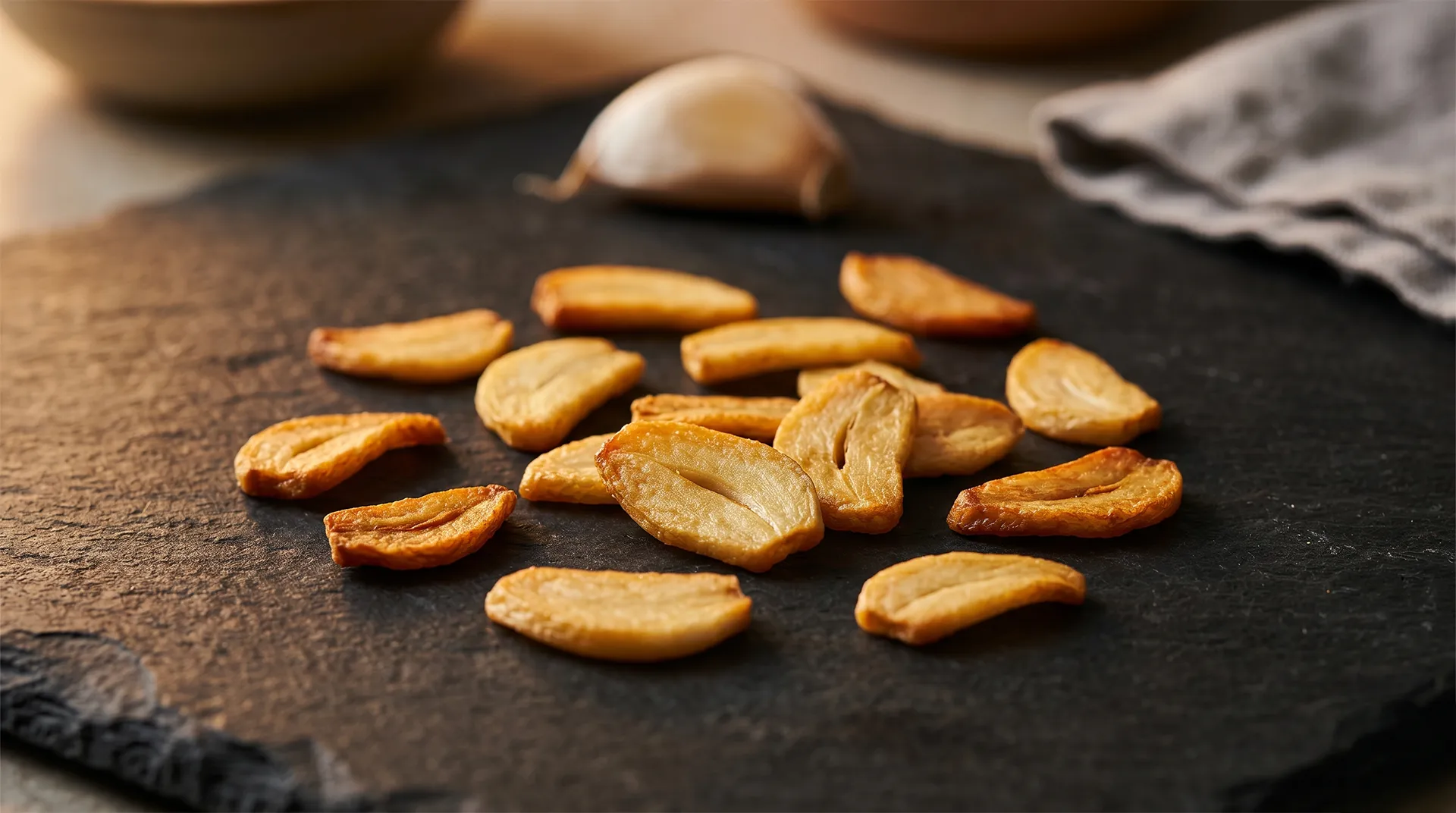
Paper-thin slices of garlic, fried low and slow until golden, shatteringly crisp, and fully caramelized.
Yield: ~30 crisps (garnish for 4–6 plates) | Prep: 10 min | Cook: 8–12 min | Total: ~20 min
Headnote
Garlic crisps live in the high-risk, high-reward register of garnish work: slice too thick and you get a chewy, bitter disc; rush the fry and the outside chars before the moisture inside escapes. The answer to both problems is the same — low heat, thin slices, and patience. A mandoline makes the first condition non-negotiable; the low oil temperature at 140°C/285°F handles the second. At that temperature, the garlic fries long enough for moisture to evacuate completely and sugars to caramelize into a deep, nutty sweetness, with none of the acrid edge that higher heat introduces.
Teaching Idea: Low-Temperature Frying for Volatile Alliums. Garlic contains sulfur compounds (allicin and related thiosulfinates) that convert rapidly to bitter, acrid flavors under aggressive heat. By frying at 140°C/285°F rather than standard frying temperatures, you move the moisture-evacuation and Maillard browning processes into a slower, gentler register — enough heat to drive out water and caramelize sugars, not enough to volatilize and burn the sulfur compounds before the slice is done.
Ingredients
The Crisps
- 6 large cloves garlic (approximately 60 g), peeled
- 280 g (1 ¼ cups) neutral oil (grapeseed or sunflower)
- Diamond Crystal kosher salt, for finishing
Mise en Place (Action Checklist)
- Peel and root all garlic cloves.
- Slice on a mandoline at 1 mm (the thinnest consistent setting on most home mandolines): uniform thickness is the single largest variable in even frying. Hand-slicing is not a substitute — even a few thick slices will burn before the rest are done.
- Set a wire rack over a paper towel–lined sheet tray to receive the finished crisps.
- Prepare a slotted spoon or spider for retrieval.
- Pour 280 g (1¼ cups) neutral oil (grapeseed or sunflower) into a small, high-sided saucepan — a narrow vessel maintains temperature more consistently with small batches than a wide pan. Clip a probe thermometer to the side.
Method
Phase 1 — Blanch to Temper
Place the sliced garlic in a small saucepan and cover with cold water. Bring to a boil over medium-high heat. As soon as the water reaches a full boil, watch the garlic: you are looking for the moment the raw, sharp smell softens and the slices begin to turn just barely translucent at the edges — like they have exhaled. They will lose their stiff, glassy opacity and go slightly limp, without going soft. That is the window. Drain immediately.
Why: A single blanch removes the sharpest sulfur compounds from the surface of the garlic, producing a cleaner, rounder flavor in the finished crisp — mellowed but still unmistakably garlic. Remove it too early and the raw edge survives the fry. Overshoot and the slice becomes fragile and absorbs too much oil.
Phase 2 — Drain
Spread the drained slices in a single layer on a clean kitchen towel or paper towels and pat dry. This step is about spatter safety, not flavor: wet garlic hitting hot oil at 140°C/285°F will cause the water to flash to steam instantly, throwing oil out of the pan. A 2–3 minute rest on the towel is sufficient. The garlic does not need to be bone-dry — it needs to be dry enough not to pop aggressively when it enters the oil.
If working fast, skip the rest and drop the slices directly after a firm blot. The video technique works this way without incident, provided you lower slices in gently rather than dropping them from height.
Phase 3 — Fry
Heat the oil to 140°C/285°F over medium heat. Once at temperature, lower the garlic slices into the oil in a single uncrowded layer — work in batches. The oil will bubble gently. You are watching for color and listening for sound.
Sensory Cues:
- At the start: pale, soft slices surrounded by a gentle, even hiss.
- At the midpoint: slices begin to turn a pale gold at the edges, stiffen slightly, and the hiss intensifies as remaining moisture leaves.
- The finish: slices are uniformly deep golden — the color of toasted bread, not caramel — and the hiss drops to a whisper. The bubbling slows dramatically because the water is gone. Pull them at this drop in sound. They will look ever so slightly underdone; they will crisp fully on the rack.
Do not wait for them to look done in the oil. Garlic carries over heat aggressively. The moment they are uniformly gold and the bubbling quiets, they come out.
Phase 4 — Finish
Transfer immediately to the prepared wire rack. Season with Diamond Crystal kosher salt while hot. Do not stack — they must breathe to stay crisp.
Chef’s Notes
Use immediately. Garlic crisps are a last-minute garnish. They begin to soften within minutes of hitting the air — residual moisture in the plate environment accelerates this. Fry them as the plate is being built, season them on the rack, and place them directly. There is no storage window worth accounting for.
Mandoline — no exceptions. The 1 mm target is not achievable by hand with any consistency. One thick slice fries at a different rate than the rest, and will be bitter or still chewy while the thin slices are done. If a mandoline is not available, garlic crisps are not the garnish for this service.
Oil temperature is the anchor. 140°C/285°F is the correct temperature. At 160°C/320°F, the exterior browns before the interior moisture evacuates and the slice goes bitter. Below 130°C/265°F, the fry is too slow and the slice absorbs oil before it crisps. Use a probe thermometer, not a guess.
Batch discipline. Overcrowding drops the oil temperature and causes slices to steam rather than fry. No more than a single flat layer per batch. Bring the oil back to temperature between batches.
Glossary
- Allicin: The primary sulfur compound produced when raw garlic is cut or crushed; responsible for garlic’s sharp, pungent aroma. Breaks down with heat — at high temperatures, it converts to acrid, bitter compounds; at low temperatures, it mellows into sweeter, nuttier flavors.
- Maillard reaction: A non-enzymatic browning reaction between amino acids and reducing sugars, triggered by heat; responsible for the golden color and complex roasted flavor in properly fried garlic.
- Blanch: To briefly submerge an ingredient in boiling water, then drain; used here to temper the sharpest sulfur compounds on the garlic surface before frying.
- Carry-over cooking: The continuation of cooking after a food is removed from its heat source, driven by residual internal heat. Critical here: garlic crisps removed from oil continue to darken for 15–20 seconds on the rack.