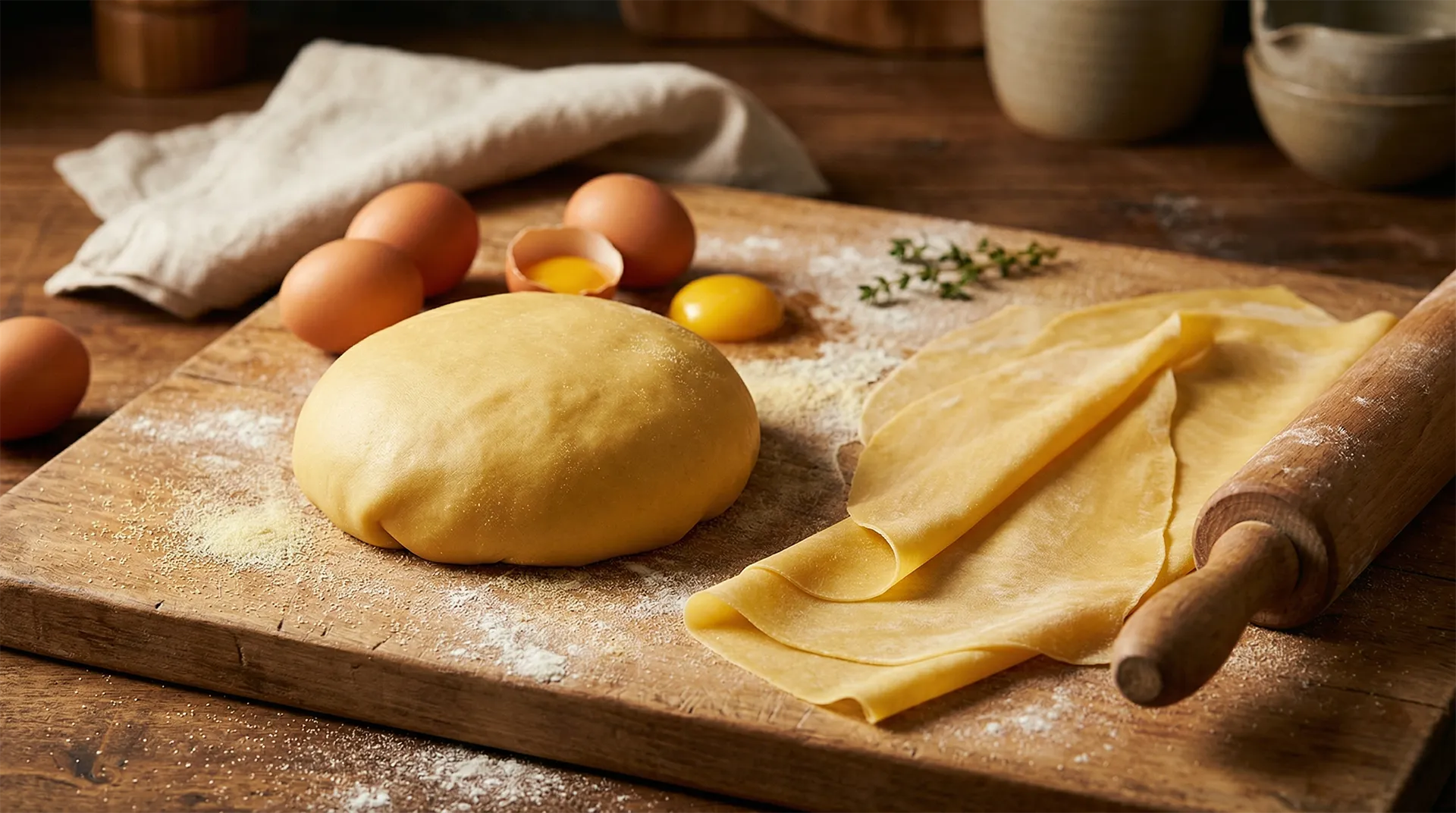
Chapter 12 · Les Fonds
The Definitive Guide to Egg Pasta
A master foundation dough yielding silky, golden pasta with a tender bite and clean egg flavor — the cornerstone of the Italian kitchen.
Yield: ~4 portions | Prep: 20 min | Inactive: 30 min | Total: ~50 min (plus rolling)
Headnote
This is not a recipe — it is a skill. Egg pasta dough is one of the few preparations in the kitchen where your hands are the only real measuring tool that matters. The formula is fixed; the feel is learned. Every batch teaches you something the last one did not.
Teaching Idea: Gluten Development. When flour and water combine and are worked mechanically, the proteins glutenin and gliadin bond to form gluten — an elastic network that gives pasta its structure and chew. The rest period after mixing is not optional; it is when that network relaxes enough to be rolled thin without springing back.
Ingredients
The Dough
- 300 g (2 ½ cups) 00 flour or King Arthur Bread Flour
- 2 large eggs (approximately 100 g)
- 3 large egg yolks (approximately 54 g)
- water — weigh your eggs, subtract from 285 g, add that amount of water
- 1 pinch Diamond Crystal kosher salt
For the Boil
- 6 quarts (5.7 L) water
- 65 g (3 ½ tbsp) Diamond Crystal kosher salt
Mise en Place (Action Checklist)
- Weigh the flour and set aside in a mound or bowl.
- Crack 2 whole eggs and 3 yolks into a bowl or measuring cup and weigh them. Note that weight. Subtract it from 285 g — that is how much water to add. Combine eggs and water; whisk briefly to marry, not to aerate.
- If mixing by hand: clear a large work surface and have a bench scraper ready.
- If using a food processor or stand mixer: have the machine ready before you begin.
- Set out plastic wrap for resting.
Method
Phase 1: Mixing
Option A — By Hand (The Well Method)
Form the flour into a mound on your work surface. Create a wide, deep well in the center — wide enough to hold all wet ingredients without breaking. Pour the egg and water mixture into the well along with the salt. Using a fork, begin beating the wet ingredients while slowly dragging flour in from the inner walls. Work from the inside out — do not collapse the walls too quickly or the liquid will escape. Once too thick for a fork, use your hands and bench scraper to bring the dough together. Knead using the ball-roll-turn method for 8–10 minutes until smooth and cohesive.
Sensory Cue: The dough should feel like warm Play-Doh — smooth, supple, not sticky, not cracking at the edges.
Option B — Food Processor
Add the flour first and pulse once to aerate. With the machine running, pour the egg mixture through the feed tube. Process until the dough just comes together into a shaggy mass. Scrape every bit onto your work surface and knead by hand using the ball-roll-turn method for an additional 5 minutes.
Option C — Stand Mixer
Add the wet ingredients to the bowl first, whisking briefly to combine. Add the flour and salt. Mix on medium-low with the dough hook for 8–10 minutes. Scrape all bits from the bowl and hook back into the dough. Finish by hand using the ball-roll-turn method for 2 minutes.
If the dough fights you: Wrap in plastic and rest for 15 minutes. This allows the gluten to relax. Finish kneading after the rest.
If the dough is sticky: Add flour 1 tsp at a time, working it in fully between additions.
Phase 2: Rest
Form the dough into a smooth ball. Wrap tightly in plastic wrap — no exposed surfaces. Rest at room temperature for 30 minutes.
Why: The rest relaxes the gluten network developed during kneading. Without it, the dough will spring back when rolled and fight every thickness setting.
Phase 3: Rolling (KitchenAid Pasta Roller Attachment)
Divide the rested dough into 4 equal portions. Keep all portions not being worked wrapped in plastic — they dry out quickly on contact with air.
Working one portion at a time, flatten into a rough rectangle no wider than the pasta roller opening.
Step 1 — Lamination Pass: Set the roller to its thickest setting. Pass the dough through 2–3 times. Fold the dough — first a half fold, then in thirds like a letter as it becomes more pliable. This builds structure and drives you toward a clean rectangle.
Step 2 — Progressive Thinning: Move through the settings one number at a time. Do not skip settings. Roll each setting once.
Target Thickness by Pasta Type:
| Pasta Type | KitchenAid Setting |
|---|---|
| Pappardelle | 5 |
| Tagliatelle / Fettuccine | 5–6 |
| Lasagne sheets | 6–7 |
| Ravioli / Tortellini | 7–8 (hold sheet to light — you should see your hand through it) |
Phase 4: The Boil
Add water to your pot — no salt yet. Cover and bring to a full rolling boil. Once boiling, add the salt and stir to dissolve. Allow the water to return to a rolling boil before adding pasta.
To prevent boil-overs: Wipe a thin film of olive oil around the inner rim of the pot, or rest a wooden spoon across the top.
Add pasta and cook per the chart below. Fresh pasta cooks fast — stay at the pot.
Fresh Pasta Cook Times:
| Pasta Type | Cook Time |
|---|---|
| Tagliatelle / Fettuccine | 1–2 min |
| Pappardelle | 2–3 min |
| Lasagne sheets (par-cook) | 2 min |
| Ravioli / Tortellini | 3–4 min |
| Gnocchi | Float + 30 sec |
Critical: Do not drain through a colander. The flour sediment that settles at the bottom of the pot will coat your pasta in over-hydrated, sticky gluten paste. Use a spider skimmer or tongs to lift the pasta directly into your sauce.
Variations
- Variant: For the rich yolk laminated version of this dough, see Recipe 12-07. For the spinach variant, see Recipe 12-10.
Chef’s Notes
- Flour Choice: Both 00 and King Arthur Bread Flour work with this formula. 00 flour produces a silkier, more delicate sheet — the classic choice for rolled pasta. Bread flour has higher protein content, producing a slightly chewier, more rustic result. If using bread flour, extend the rest in Phase 2 to 45 minutes.
- Egg vs. Water Pasta: Egg yolks introduce fat, which shortens gluten strands slightly, producing a more tender, richer dough that rolls thinner with less resistance. Water pasta (orecchiette, cavatelli) relies entirely on gluten development for structure, producing a chewier result with better hold in heavy braises and ragù. Egg pasta’s richness makes it the natural pairing for butter- and cream-based sauces.
- Drying Before Cutting: Allow rolled sheets to dry on a floured surface or pasta rack for 5–10 minutes before cutting. A slightly tacky but not wet sheet cuts cleanly without sticking to itself.
- Make-Ahead: Finished dough can be refrigerated wrapped in plastic for up to 24 hours. Return to room temperature for 20 minutes before rolling.
Glossary
- Gluten: An elastic protein network formed when glutenin and gliadin in flour combine with water and are mechanically worked. Gives pasta its structure and chew.
- Lamination (Pasta): The process of folding and re-rolling pasta dough through the thickest roller setting to build structure and achieve a uniform rectangular sheet.
- Well Method: A hand-mixing technique where flour is mounded and hollowed at the center to contain wet ingredients, incorporated gradually from the inside out.
- Spider Skimmer: A wide, shallow wire-mesh tool used to lift pasta from cooking liquid without a colander.
- Ball-Roll-Turn: A hand-kneading method where the dough is pushed forward with the heel of the hand, rolled back into a ball, and rotated 90° before the next push — building even gluten development in all directions.
- 00 Flour: Finely milled Italian flour with lower protein content (typically 9–11%). Produces a silky, extensible dough ideal for rolled pasta.