Chapter 12 · Les Fonds
The Quintessential Spinach Pasta
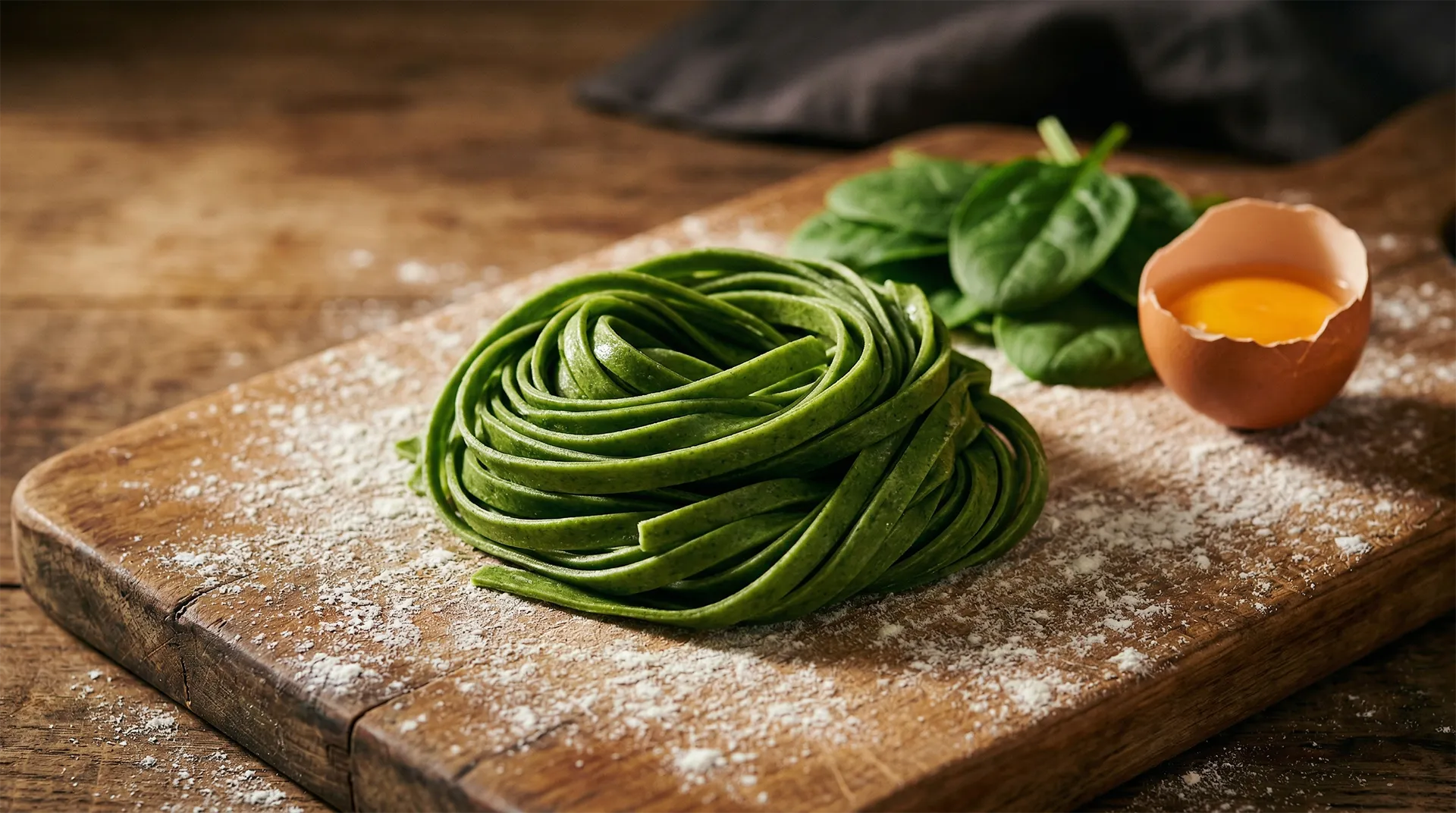
Silky, jade-green pasta with a mineral depth and subtle garlic warmth — built on the same hydration logic as the master egg dough, with spinach puréed directly into the eggs.
Yield: ~4 portions | Prep: 35 min | Inactive: 45 min | Total: ~1 hr 20 min (plus rolling)
Headnote
This is the egg pasta formula transposed into a new key. The hydration math does not change — only what delivers it. Spinach is sautéed until bone dry, then puréed directly into the eggs, contributing color and mineral flavor without disrupting the liquid calculation. Water closes the gap to 285 g as it always does. That fiber is why this dough rests 15 minutes longer than the base formula: the gluten network needs more time to relax before it will roll without resistance.
Teaching Idea: Chlorophyll Degradation. The vivid green of raw spinach comes from chlorophyll, a pigment chemically stable at room temperature but which degrades rapidly above 70°C/158°F. Cooking drives off moisture and concentrates flavor; the color shift from bright green to olive-green during the boil is chemistry, not error.
Ingredients
Part 1: The Purée
- 50–75 g mature flat-leaf spinach, stems removed (raw weight)
- 5 g (1 tsp) garlic-infused olive oil
Part 2: The Dough
- 300 g (2 ½ cups) 00 flour or King Arthur Bread Flour
- 2 large eggs (approximately 100 g)
- 3 large egg yolks (approximately 54 g)
- water — weigh eggs + spinach purée combined, subtract from 285 g, top up with that amount of cold water
- 1 g (¼ tsp) freshly grated nutmeg
- 1 pinch Diamond Crystal kosher salt
For the Boil
- 6 quarts (5.7 L) water
- 65 g (3 ½ tbsp) Diamond Crystal kosher salt
Mise en Place (Action Checklist)
- Weigh the flour and set aside in a mound or bowl.
- Crack 2 whole eggs and 3 yolks into a bowl or measuring cup — do not weigh yet; the spinach purée goes in first.
- Have a blender or immersion blender ready for the spinach.
- If mixing by hand: clear a large work surface and have a bench scraper ready.
- If using a food processor or stand mixer: have the machine ready before you begin.
- Set out plastic wrap for resting.
Method
Part 1: The Purée
Phase 1: Sauté & Dry Heat the garlic-infused olive oil in a small skillet over medium heat. Add the spinach and sauté, turning frequently, until completely wilted and all visible moisture has evaporated from the pan, 3–4 minutes.
Sensory Cue: The spinach is ready when it no longer releases liquid when pressed with a spoon and the pan is dry. Any residual moisture will throw off the hydration calculation.
Transfer to a clean kitchen towel and squeeze firmly to remove any remaining moisture. The mass should feel dry and compact.
Phase 2: Purée Transfer the squeezed spinach to a blender. Add the eggs and egg yolks directly. Blend on high until completely smooth with no fibrous threads remaining. The mixture should be uniformly deep green.
Weigh the spinach-egg mixture. Subtract that weight from 285 g — that is how much cold water to add. Whisk the water in briefly to combine.
Example: If your egg and spinach mixture weighs 162 g, add 123 g cold water.
Part 2: The Pasta
Phase 3: Mixing Add the nutmeg and salt to the spinach-egg mixture and whisk briefly to combine.
Option A — By Hand (The Well Method) Form the flour into a mound on your work surface. Create a wide, deep well in the center — wide enough to hold all the wet ingredients without breaking. Pour the spinach mixture into the well. Using a fork, begin beating the wet ingredients while slowly dragging flour in from the inner walls. Work from the inside out — do not collapse the walls prematurely or the liquid will escape. Once too thick for a fork, use your hands and bench scraper to bring the dough together. Knead using the ball-roll-turn method for 8–10 minutes until smooth and cohesive.
Sensory Cue: The dough should feel like firm Play-Doh — smooth, supple, and jade green throughout. If you see white streaks, keep kneading.
Option B — Food Processor Add the flour first and pulse once to aerate. With the machine running, pour the spinach mixture through the feed tube. Process until the dough just comes together into a shaggy mass. Scrape onto your work surface and knead by hand using the ball-roll-turn method for 5 minutes.
Option C — Stand Mixer Add the spinach mixture to the bowl first. Add flour and salt. Mix on medium-low with the dough hook for 8–10 minutes. Scrape all bits from bowl and hook back into the dough. Finish by hand using the ball-roll-turn method for 2 minutes.
If the dough fights you: Wrap in plastic and rest 15 minutes. The spinach fiber makes this dough slightly stiffer than the base formula — resistance early is normal. Finish kneading after the rest.
If the dough is sticky: Add flour 1 tsp at a time, working it in fully between additions.
Phase 4: Rest Form the dough into a smooth ball. Wrap tightly in plastic wrap — no exposed surfaces. Rest at room temperature for 45 minutes.
Why: Spinach fiber physically interrupts gluten strand continuity, requiring additional time for the network to relax fully. Shortcutting this rest produces a dough that springs back under the roller and fights every setting.
Phase 5: Rolling (KitchenAid Pasta Roller Attachment) Divide the rested dough into 4 equal portions. Keep all unwrapped portions covered in plastic — this dough dries and oxidizes faster than the base egg dough.
Working one portion at a time, flatten by hand into a rough rectangle no wider than the roller opening.
Step 1 — Lamination Pass: Set the roller to its thickest setting. Pass the dough through 2–3 times. Fold — first a half fold, then in thirds like a letter as it becomes more pliable. This builds structure and drives you toward a clean rectangle.
Step 2 — Progressive Thinning: Move through settings one number at a time. Do not skip settings. Roll each setting once.
Target Thickness by Pasta Type:
| Pasta Type | KitchenAid Setting |
|---|---|
| Pappardelle | 5 |
| Tagliatelle / Fettuccine | 5–6 |
| Lasagne sheets | 6–7 |
| Ravioli / Tortellini | 7–8 (hold to light — you should see your hand through it) |
Phase 6: The Boil Add water to your pot — no salt yet. Cover and bring to a full rolling boil. Once boiling, add the salt and stir to dissolve. Allow the water to return to a full rolling boil before adding pasta.
To prevent boil-overs: Wipe a thin film of olive oil around the inner rim of the pot, or rest a wooden spoon across the top.
Fresh Pasta Cook Times:
| Pasta Type | Cook Time |
|---|---|
| Tagliatelle / Fettuccine | 1–2 min |
| Pappardelle | 2–3 min |
| Lasagne sheets (par-cook) | 2 min |
| Ravioli / Tortellini | 3–4 min |
Critical: Do not drain through a colander. Use a spider skimmer or tongs to lift pasta directly into your sauce.
Chef’s Notes
- The Color Shift: Expect the pasta to move from jade green in the dough to olive-green once boiled. This is chlorophyll degrading under sustained heat — it is not a failure. Plan plating accordingly: bright garnishes (lemon zest, chives, raw pea shoots) restore visual contrast.
- Spinach Variety: Mature flat-leaf spinach is specified for its lower water content and more concentrated mineral flavor. Baby spinach can be substituted but produces a milder, slightly paler result.
- The Garlic Oil: The quantity here (5 g) is intentionally restrained. This dough is designed to pair with Recipe 10-21 (Lemon Cream & Parmigiano Sauce), where the lemon already leads. The garlic in the dough provides a savory undertone without competing with the acid in the sauce. If pairing with a butter-sage application, the garlic oil can be increased to 10 g.
- Make-Ahead: Finished dough can be refrigerated wrapped in plastic for up to 24 hours. Return to room temperature for 20 minutes before rolling. The green color will deepen slightly in the refrigerator — this is normal.
- Drying Before Cutting: Allow rolled sheets to dry on a floured surface or pasta rack for 5–10 minutes before cutting.
- Foundation Reference: For the complete egg pasta guide covering all mixing methods, rolling settings, and cook times, see Recipe 12-09.
Glossary
- Chlorophyll: The green pigment in plant cells. Heat-sensitive above 70°C/158°F, causing the shift from bright green to olive-drab during cooking.
- Gluten: An elastic protein network formed when glutenin and gliadin in flour combine with water and are mechanically worked. Gives pasta its structure and chew.
- Lamination (Pasta): The process of folding and re-rolling dough through the thickest roller setting to build structure and achieve a uniform rectangular sheet.
- Well Method: A hand-mixing technique where flour is mounded and hollowed at the center to contain wet ingredients, incorporated gradually from the inside out.
- Spider Skimmer: A wide, shallow wire-mesh tool used to lift pasta from cooking liquid without a colander.
- Ball-Roll-Turn: A hand-kneading method where dough is pushed forward with the heel of the hand, rolled back into a ball, and rotated 90° before the next push.
- 00 Flour: Finely milled Italian flour with lower protein content (typically 9–11%). Produces a silky, extensible dough ideal for rolled pasta.
- Garlic-Infused Oil: Olive oil gently heated with crushed garlic until fragrant, then strained. Delivers garlic flavor without the sharpness of raw garlic.