Chapter 8 · The Field
Onion Potato Crisps
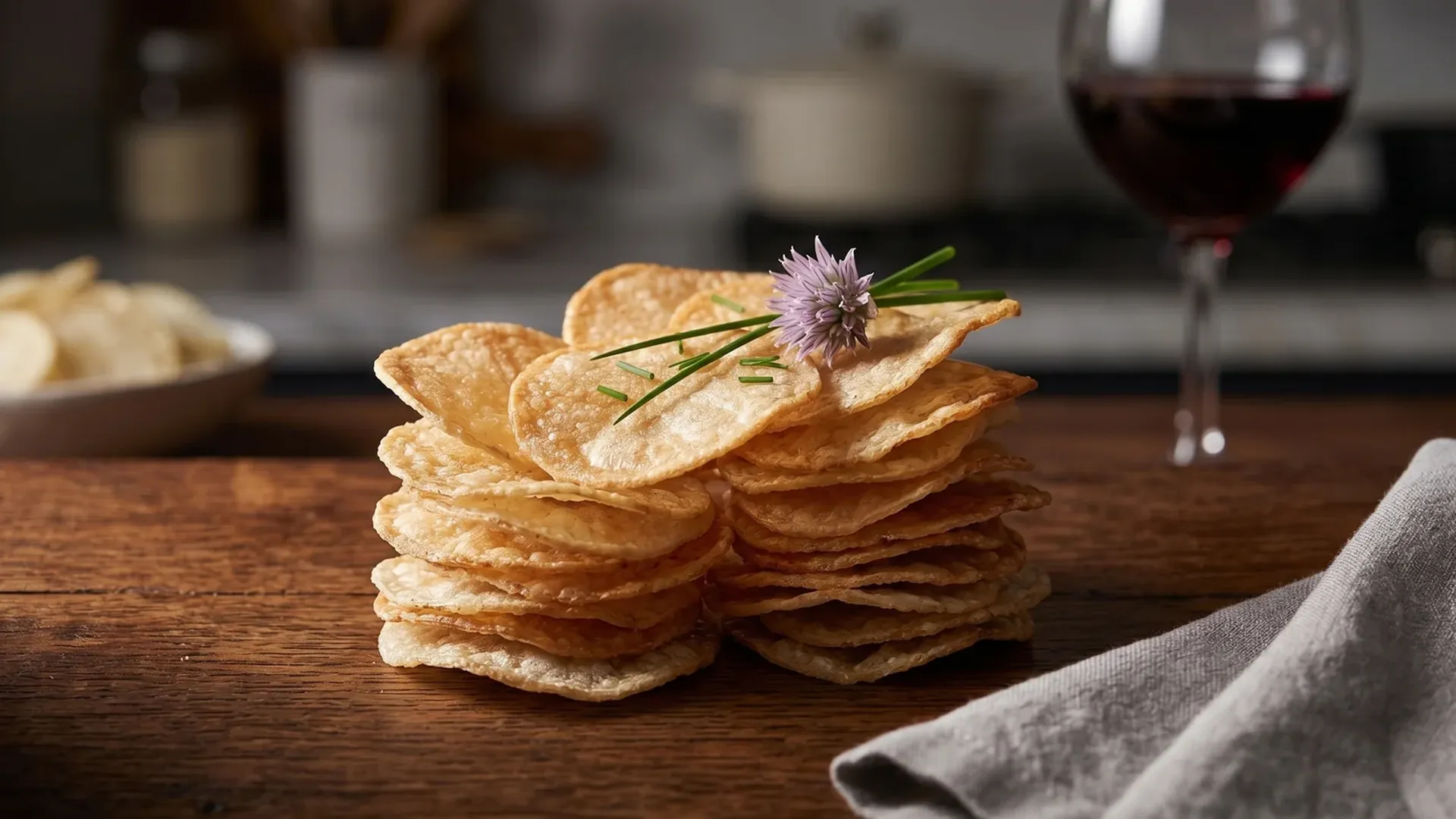
Light, shatter-crisp vegetable tuiles leveraging potato amylopectin and raw onion aromatics for a concentrated savory snack.
Yield: 40 pieces | Prep: 20 min | Cook: 30 min | Total: 50 min
Headnote
This technique utilizes the high amylopectin content of Yukon Gold potatoes to create a stable, glassy matrix. By incorporating raw onion into the hot potato emulsion, we preserve the volatile sulfur compounds that would otherwise be lost during a pre-cook, resulting in a more vibrant aromatic profile.
Teaching Idea: Starch Gelatinization & Internal Vapor Pressure. Adding a precise amount of baking powder creates microscopic CO₂ bubbles that expand during the early stage of baking. These pockets weaken the starch wall just enough to provide a delicate “shatter” texture rather than a hard, chip-like crunch.
Ingredients
- 200 g (approx. 1½ cups) Yukon Gold potatoes, peeled and cubed
- 100 g (approx. 1 small) yellow onion, chopped
- 50 g (3½ tbsp) potato cooking water, boiling
- 50 g (⅓ cup) potato starch (plus 10 g reserved if needed)
- 2 g (½ tsp) baking powder
- 2 g (pinch) kosher salt
Mise en Place (Action Checklist)
- Peel and cube the Yukon Gold potatoes into 1-inch (2.5 cm) pieces.
- Roughly chop the yellow onion.
- Measure the potato starch and baking powder.
- Prepare two large baking sheets with parchment paper.
- Prepare a pastry bag without a tip (or snip the corner).
Method
Phase 1: Build the Emulsion Place potatoes in a pot of cold salted water. Bring to a boil and cook for 12–15 minutes until fork-tender. Reserve 50 g of the boiling water, then drain the potatoes. Transfer the potatoes immediately to a high-speed blender — they must be used while still steaming hot to achieve the emulsion. Add the raw onions and the reserved 50 g of boiling potato water. Blend on high for 60–90 seconds until the mixture is a completely smooth, glossy emulsion.
Phase 2: Build the Matrix Transfer the warm potato mixture to a bowl. Sift in the potato starch, baking powder, and salt. Whisk vigorously until no lumps remain. The batter should hold a thick “ribbon” stage. If the mixture is too fluid to hold its shape when piped, whisk in the additional 10 g of potato starch.
Phase 3: Pipe and Press Preheat the oven to 230°F/110°C. Transfer the mixture to a piping bag. Pipe 1-inch (2.5 cm) dollops onto the parchment-lined baking sheet, spaced 2 inches (5 cm) apart. Place a second sheet of parchment paper over the dollops. Use the flat bottom of a measuring cup to press each dollop into a thin, uniform disc approximately 2–3 inches (5–7.5 cm) wide. Carefully peel back the top parchment layer.
Phase 4: Dehydrate and Set Bake for 30–35 minutes until the crisps are completely dehydrated and lift easily from the paper without sticking. They should be pale with almost no browning. Transfer the parchment sheet to a wire rack. The crisps will reach their final brittle state as they reach room temperature.
Variations
- Sour Cream & Onion: Whisk in 5 g of buttermilk powder during step 4 for a sour cream and onion profile.
Chef’s Notes
- Storage: These are highly hygroscopic (they absorb moisture from the air). Store immediately in an airtight container with a silica desiccant pack to maintain crunch.
Glossary
- Amylopectin: A highly branched polymer of glucose found in plants. In potatoes, it is responsible for the “sticky” and “glassy” qualities of a cooked starch gel.
- Gelatinization: The process where starch granules absorb water and swell when heated, eventually breaking open and forming a thickened gel.
- Maillard Reaction: A chemical reaction between amino acids and reducing sugars that gives browned food its distinctive flavor. We bake at a lower temperature to minimize this and keep the onion flavor “fresh.”