Chapter 3 · Garde Manger
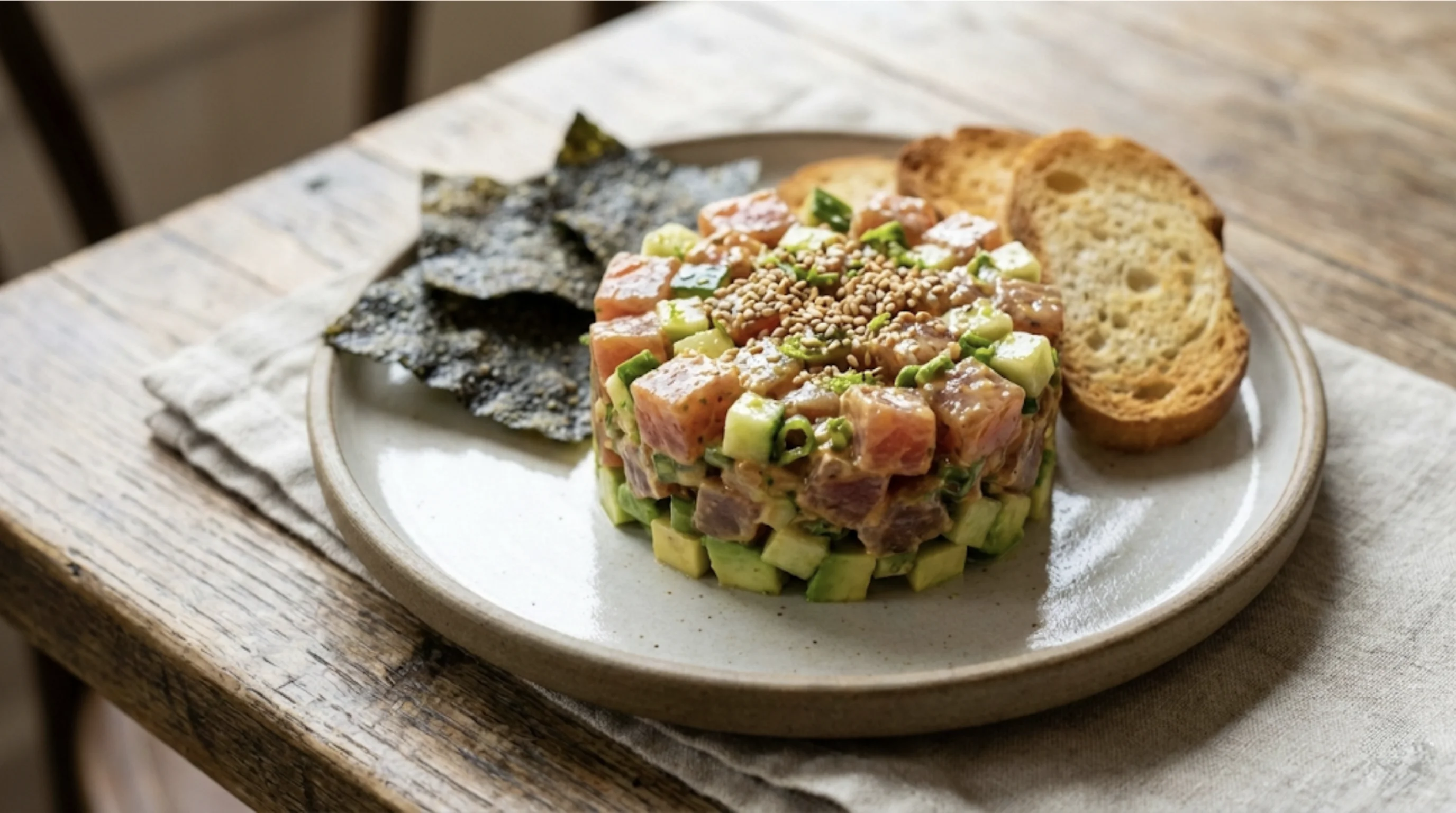
Spicy Sesame & Yuzu Tuna Tartare
Pristine raw tuna dressed in a vibrant chili-emulsion, served with avocado and crispy shallots.
Yield: 4 servings | Prep: 30 min | Cook: 0 min | Total: 30 min
Headnote
We bridge the gap between a Japanese spicy tuna roll and a Mediterranean tartare by using a stable emulsion to bind the fish rather than a simple vinaigrette. This coating protects the proteins from oxidizing while delivering a creamy, lingering heat.
Teaching Idea: The “Sushi Grade” Reality. “Sushi Grade” is a marketing term, not a regulation. To ensure safety from parasites, you must source fish that has been commercially super-frozen to -4°F (-20°C) for 7 days. Never freeze “fresh” supermarket fish yourself for raw consumption; home freezers are not cold enough or fast enough to guarantee safety.
Ingredients
The Protein
- 340 g (12 oz) Yellowfin or Bigeye Tuna (Saku Block, frozen/thawed), pat dry
- 1 Avocado, ripe but firm
The Emulsion
- 30 g (2 tbsp) Japanese Mayonnaise (Kewpie)
- 15 g (1 tbsp) Sriracha or Gochujang paste
- 5 ml (1 tsp) Sesame Oil, toasted
- 5 ml (1 tsp) Soy Sauce (Tamari if gluten-free)
- 1 Lime or Yuzu — zest finely grated; juice squeezed and held separately for finishing
The Crunch
- 1 Persian Cucumber
- 2 Scallions, green parts only
- 5 g (1 tsp) Sesame Seeds, toasted
- 2 g (½ tsp) Diamond Crystal Kosher Salt
Mise en Place (Action Checklist)
- Chill the Gear: Place a metal mixing bowl inside a larger bowl filled with ice (an ice bath).
- Sharpen Your Knife: A dull knife will mash the tuna structure rather than slicing it.
- Prepare the Board: Sanitize your cutting board. Ensure no cross-contamination from other ingredients.
Method
Phase 1: Toast the Sesame Seeds
In a dry pan over medium heat, toast the sesame seeds, stirring frequently, for 2–3 minutes.
Sensory Cue: The seeds should turn golden and smell nutty and fragrant. Transfer immediately to a plate to cool completely — they will continue to darken briefly from residual heat.
Phase 2: The Vegetable Brunoise
Using your sharpest knife, slice the cucumber into thin planks, then strips, then tiny cubes (brunoise). Finely slice the scallions.
Why: Cutting the vegetables first keeps your board clean for the fish and ensures the garnish is ready the moment the fish is cut.
Phase 3: The Protein Fabrication
Retrieve the tuna from the refrigerator. Slice the block against the grain into ¼-inch slabs. Cut the slabs into strips, then dice into ¼-inch cubes.
Sensory Cue: The fish should look like jewels, not mush. If it starts to look “pasty,” your knife is too dull or the fish is getting too warm. Immediately transfer the diced tuna to the chilled metal bowl sitting in the ice bath.
Phase 4: The Emulsion
In a separate small bowl, whisk together the mayonnaise, sriracha, sesame oil, and soy sauce until uniform and glossy.
Why: Premixing the binder ensures even distribution without overworking the delicate fish.
Phase 5: Assembly
Add the cucumber, scallions, and lime zest to the chilled tuna. Pour the emulsion over the mixture. Using a rubber spatula, gently fold the mixture just until the tuna is coated.
Why: We fold gently to preserve the integrity of the cubes. Add the salt and a squeeze of lime juice immediately before plating.
Why: Acid (lime juice) and salt will draw moisture out of the fish and begin to “cook” it (denaturation). Adding them last keeps the texture firm.
Phase 6: Plating
Dice the avocado and place it at the bottom of a ring mold (or bowl). Top with the tuna tartare mixture. Garnish with toasted sesame seeds. Serve immediately with nori chips or crostini.
Chef’s Notes
- The Saku Block: “Saku” refers to a uniform block of frozen tuna loin, trimmed of sinew and skin. This is the safest and easiest cut for tartare.
- Texture Modifier: For added crunch, mix in 1 tbsp of crushed fried shallots or tempura flakes just before serving.
- Acid Control: Never marinate the tuna in the lime juice. This turns the dish into Ceviche, which changes the texture from silky to firm/chalky.
Glossary
- Brunoise: A very fine dice (⅛ inch), used to ensure the garnish doesn’t overpower the main ingredient.
- Emulsion: A mixture of two liquids that don’t normally mix (like oil and water/vinegar), held together by a stabilizer (in this case, the egg yolk in the mayonnaise).
- Saku: A standardized block of frozen fish loin, specifically trimmed for sashimi/sushi use.
- Mayonnaise: A stable emulsion of oil and egg yolk, used here as a base for the spicy component.
- Denaturation: The process of unfolding or disrupting the structure of a protein, often triggered by heat or acid.