Chapter 2 · The Foundation
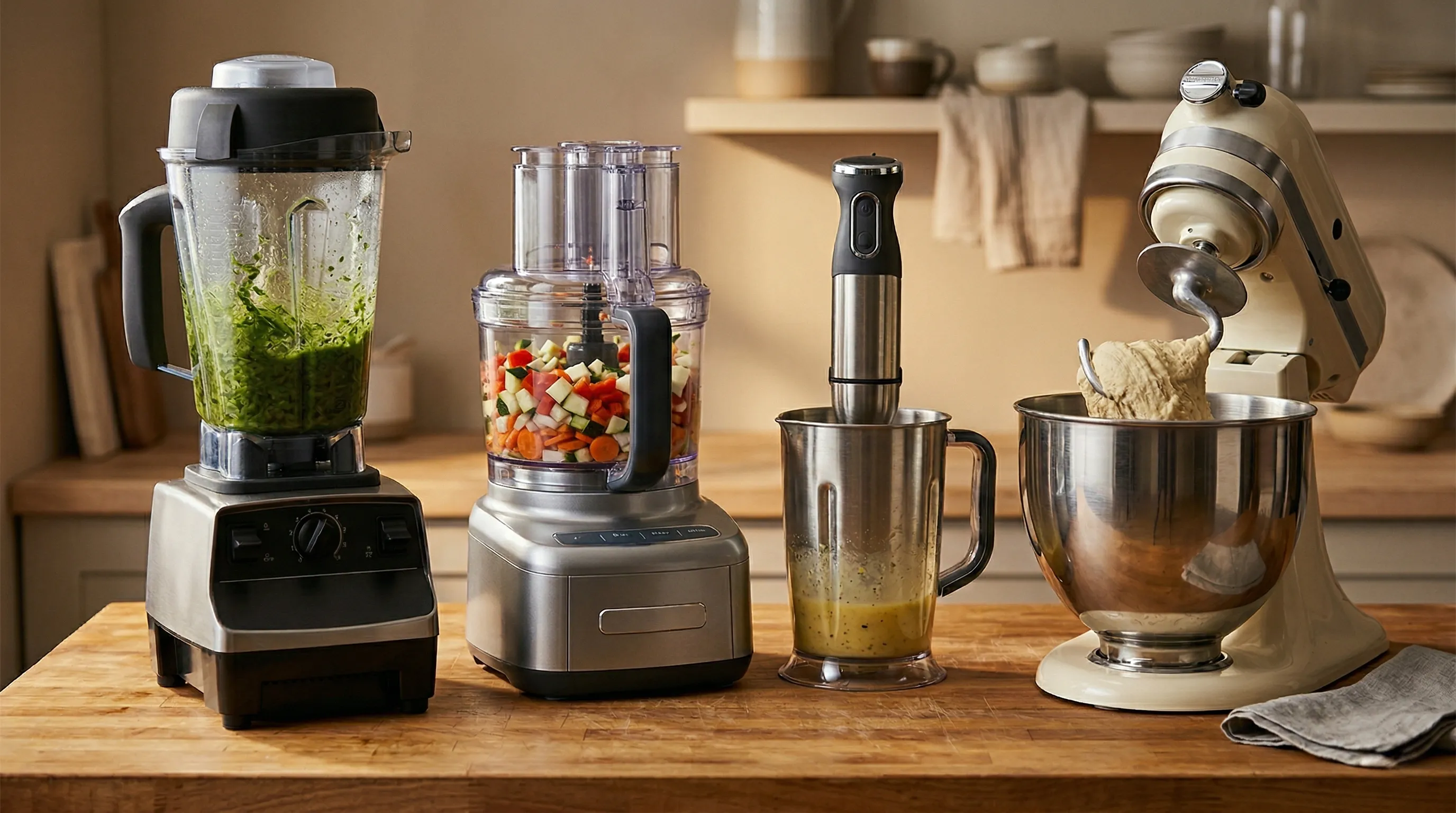
The Machine Shop (Electrics)
Concept Definition: Electric tools are not shortcuts; they are engines of Force. They provide speed and consistency that the human hand cannot match. However, they introduce a new variable: Friction Heat. While a knife cuts without heating the ingredient, a high-speed blade generates significant thermal energy. If you blend a delicate herb oil too long, you cook the herbs and turn the oil brown.
The Physics: Torque vs. Shear: To use the Machine Shop safely, you must understand the type of force being applied:
- Shear Force (Blenders): High speed, low torque. The goal is particle destruction. The blades spin fast enough to shatter cell walls.
- Torque (Stand Mixers): Low speed, high power. The goal is moving heavy mass (dough) or driving mechanical attachments without stalling.
- The Danger Zone (Friction): Energy does not disappear; it changes form. Kinetic energy becomes Thermal energy (heat). A high-speed blender running on max can boil water in 6 minutes purely through friction.
Practical Application: The Motorized Inventory
1. The High-Speed Blender (e.g., Vitamix)
- The Function: Liquefaction & Emulsification.
- Best For: Silky vegetable purees, hot soups, stable vinaigrettes.
- The Technique: “The Vortex.” Start low to grab ingredients, then ramp to high.
- Chef’s Warning: Never fill past the “Max Line” when blending hot liquids. Steam expands. If the lid is airtight, it will explode off.
2. The Immersion Blender (Stick Blender)
- The Function: In-Pot Emulsification.
- Best For: Finishing a soup without transferring it; fixing a broken sauce.
- The Technique: “Tilt and Submerge.” Keep the blade fully under the surface to prevent splashing hot liquid (safety).
3. The Food Processor
- The Function: The “Dry” Chop & Grating.
- Best For: Salsa (chunk preservation), pie dough (cutting fat into flour), or grating large volumes of cheese.
- The Distinction: Unlike a blender, a food processor does not create a vortex. It flings food outward. It is terrible for fine liquids but excellent for solids.
4. The Stand Mixer (The Engine)
- The Function: Structure Development & Fabrication.
- The Standard Tools:
- The Paddle: For creaming (cookies). Mashes ingredients to incorporate air.
- The Whisk: For aeration (meringue). Never use on heavy dough; you will snap the wires.
- The Hook: For kneading (bread). Stretches gluten strands.
5. The Power Hub (Attachments) The motor on your mixer can drive industrial-grade attachments.
- The Pasta Roller:
- Why: Unlike a rolling pin, the steel rollers apply even pressure to compress dough sheets. This “laminates” the gluten, giving pasta its “snap” (al dente texture) rather than a doughy chew.
- The Meat Grinder:
- Why: Control. Store-bought ground beef sits in a package, oxidizing. Grinding at home allows you to choose the cut (e.g., Short Rib + Brisket) and the hygiene level.
- The Science of “The Smear”: Fat melts at low temperatures. If your grinder is warm, the fat will smear rather than cut, resulting in a mealy burger. Technique: Freeze the grinder attachment and the meat cubes for 30 minutes before grinding.
- The Spiralizer / Sheet Cutter:
- Why: Mechanical Consistency. It cuts vegetables into uniform ribbons or sheets (zucchini noodles, apple sheets) that cook at the exact same rate.
Practice Exercise: The “Friction” Test Goal: Observe how mechanical force creates heat.
- Setup: Place 250ml (1 cup) of cold tap water (60°F/15°C) into a high-speed blender.
- Action: Turn the blender to maximum speed and let it run for 3 minutes.
- Result: Measure the temperature. It will likely have risen by 20–30°F.
- Lesson: If that water was a delicate fresh herb puree or a raw emulsion, you would have just cooked it. Pulse to keep things cool.
Glossary
- Torque: A rotational force applied to an object, crucial for understanding the power output of machines like stand mixers.
- Shear Force: A force applied parallel to a surface, utilized in blenders to break down cell walls and achieve particle destruction.
- Friction Heat: The conversion of kinetic energy (motion) into thermal energy (heat) due to resistance during processes like blending.
- Lamination: The process of layering dough sheets, achieved by the pasta roller, resulting in a desirable “snap” in the final product.
- Smear: The phenomenon of fat melting at low temperatures during grinding, leading to a mealy texture if the grinder is not properly chilled.