Chapter 11 · Spice Blends, Oils & Pastes
Adobo Seasoning Blend
A salt-forward, allium-rich dry blend built on garlic, oregano, and turmeric — the everyday seasoning backbone of Latin and Caribbean cooking.
Yield: ~94 g (approximately ½ cup) | Prep: 5 min | Cook: 0 min | Total: 5 min
Headnote
Adobo seasoning is not a single recipe — it is a category of dry blends found across Puerto Rican, Dominican, Cuban, and broader Latin American pantries, all sharing the same structural logic: coarse salt as the carrier, granulated garlic as the dominant aromatic, dried oregano for herbal brightness, and black pepper for heat. This version adds turmeric for its warm earthiness and subtle color contribution, and cumin for depth — both common additions in commercial and home versions. The result is a highly versatile building block that seasons proteins before the pan, lifts braises and beans mid-cook, and finishes vegetables at the table. Teaching Idea: Salt as Carrier. In a dry spice blend, salt does more than season — it acts as the physical carrier that distributes all other aromatics evenly across the surface of food. Because salt crystals are denser and larger than most dried spice particles, they provide the structural mass that keeps the blend from clumping and ensures even coverage when rubbed or dusted onto a protein.
Ingredients
The Blend
- 18 g (3 Tbsp) Diamond Crystal kosher salt
- 16 g (2 Tbsp) granulated garlic
- 9 g (2 Tbsp) dried oregano
- 16 g (1 Tbsp) ground turmeric
- 8 g (1 Tbsp) onion powder
- 7 g (1 Tbsp) freshly ground black pepper
- 10 g (2 tsp) sweet paprika
- 10 g (2 tsp) ground cumin
Mise en Place (Action Checklist)
- Measure all spices individually before combining — do not eyeball
- If grinding black pepper fresh, grind before measuring and allow to cool to room temperature; hot pepper will create condensation in the jar
- Have a small airtight jar or container ready to receive the finished blend
Method
Phase 1 — Combine
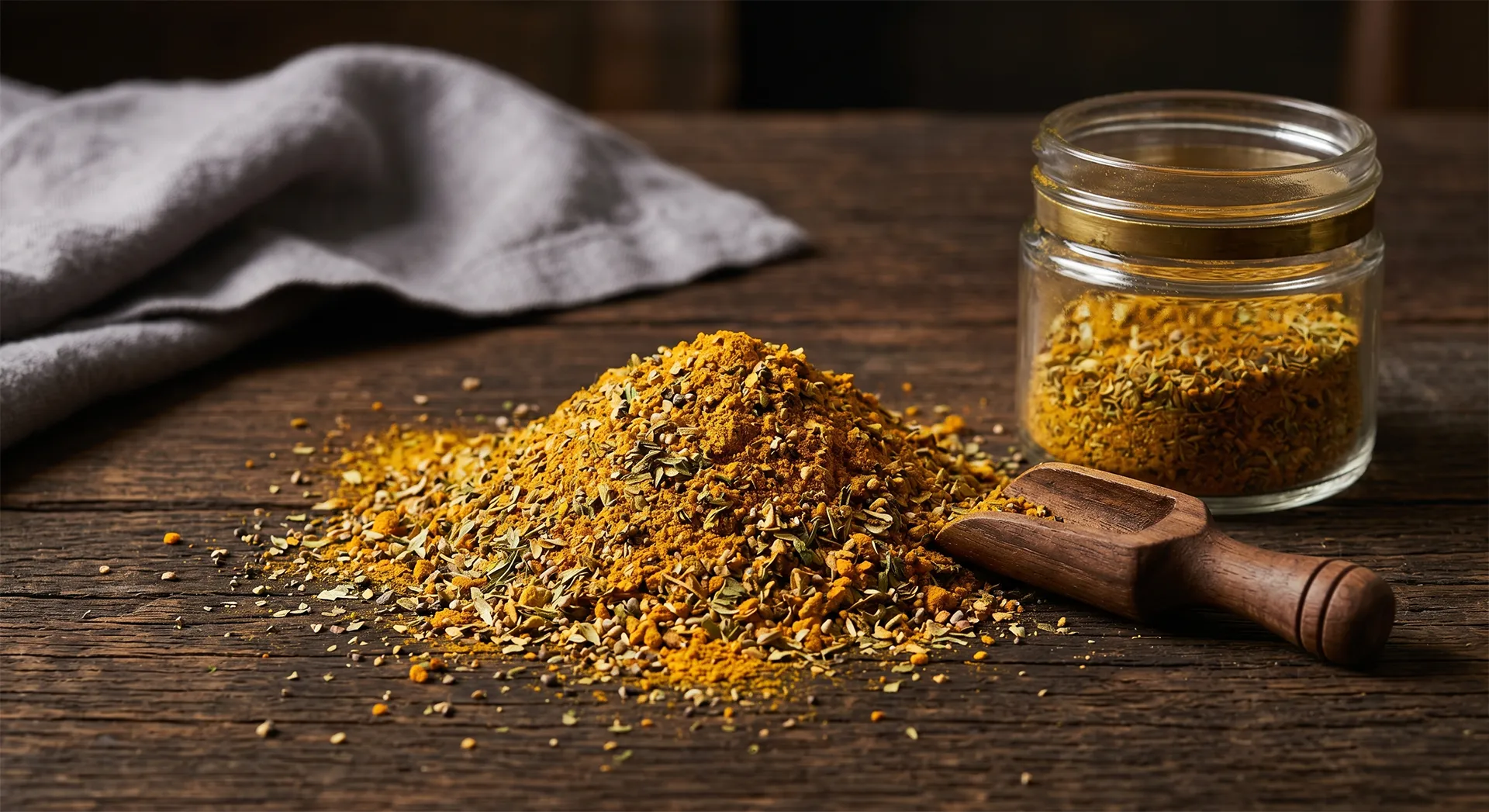
Add all measured ingredients to a small bowl. Whisk thoroughly for 30–45 seconds, breaking up any clumps in the oregano or granulated garlic. The finished blend should be uniform in color — a warm, golden-amber with visible green oregano flecks throughout.
Sensory cue: The aroma should be assertively garlicky with herbal and earthy notes from the oregano and turmeric. If the garlic dominates with no herbal lift, the oregano may have been under-measured.
Phase 2 — Store
Transfer immediately to an airtight jar. Seal tightly and label with the date. Store away from heat and direct light — a drawer or closed cabinet is correct; a shelf above the stove is not.
Sensory cue for freshness: Open the jar 24 hours after making — the resting period allows the aromatics to marry. The garlic sharpness will round slightly; the turmeric earthiness becomes more integrated. This is the correct baseline for the blend.
Variations
Lower-Sodium Version
Reduce the Diamond Crystal kosher salt to 9 g (1½ Tbsp) and increase the granulated garlic by 4 g (½ Tbsp) to compensate for the loss of carrier mass. Use this version when the blend will be applied to proteins that will be further seasoned during cooking — braises, soups, and beans especially.
Chef’s Notes
- Application rates: For proteins (chicken thighs, pork shoulder, shrimp), apply 1–1½ tsp per 450 g (1 lb) as a dry rub 30–60 minutes before cooking. For vegetables and beans, start with ½ tsp per cup and adjust to taste at the end of cooking.
- Morton’s conversion: If using Morton’s kosher salt instead of Diamond Crystal, reduce to 10 g (1½ Tbsp) — Morton’s crystals are denser and the same volume delivers significantly more sodium.
- Turmeric staining: Turmeric will stain plastic containers, white towels, and cutting boards. Use glass or stainless storage; wipe spills immediately.
- Freshness window: The blend is best within 3 months. Turmeric and oregano lose volatiles faster than the salt and garlic. Test by rubbing a pinch between your fingers — if the aroma is faint, remake a fresh batch.
- Scaling: All ingredients scale linearly. Double or triple the batch freely — the only constraint is jar capacity.
- Granulated garlic vs. garlic powder: Granulated garlic (coarser grind) is intentional here. It distributes more evenly in a coarse salt carrier and delivers a slightly more textured, burst-style garlic flavor on the surface of proteins. Garlic powder is finer and will compact more easily; if substituting, reduce by approximately 20% by weight.
Glossary
- Adobo: From the Spanish adobar (“to marinate” or “to season”). In Latin and Caribbean cooking, refers to both a seasoning blend (dry or wet) and a style of braised dish. This folio covers the dry blend form.
- Granulated Garlic: Dried garlic ground to a coarse, sand-like texture. Distinct from garlic powder, which is ground finer. The coarser particle distributes more evenly in dry blends and delivers a slightly less aggressive garlic flavor than the fine powder.
- Carrier: In a dry spice blend, the ingredient (typically salt or sugar) whose particle size and density provides the physical structure that keeps finer aromatics evenly distributed and prevents clumping.
- Volatiles: The aromatic compounds in spices and herbs that evaporate over time, causing loss of flavor and scent. Storing blends in airtight containers away from heat slows volatilization.