Chapter 10 · Stocks, Sauces & Condiments
Beurre Noisette (The Toasted Butter)
Butter cooked past melting into a fragrant, amber liquid of toasted milk solids — the most transformative single-ingredient technique in the French kitchen.
Yield: ~170–180 g finished (from 226 g / 8 oz / 2 sticks) | Prep: 2 min | Cook: 6–10 min | Total: ~12 min
Headnote
Beurre noisette begins as whole butter and ends as something categorically different: a nutty, caramel-scented fat stripped of its water and transformed by the Maillard reaction in its own milk solids. The roughly 20–25% yield reduction is not waste — it is the water leaving, making room for flavor. Unlike clarified butter, the toasted solids are kept and are the entire point. Teaching Idea: The Maillard Reaction in Fat. When butter’s milk proteins and sugars reach approximately 280°F/138°C, they undergo the same browning reaction that creates crust on a sear or color on bread. The result is dozens of new flavor compounds — nutty, toffee, and faintly bitter — that raw or melted butter simply cannot produce.
Ingredients
The Base
- 226 g (8 oz / 2 sticks) unsalted butter, cut into uniform pieces
Optional Flavor Additions (by variant — see Method)
- Lemon: 15 ml (1 tbsp) fresh lemon juice + zest of 1 lemon
- Sage: 8–10 fresh sage leaves, dried thoroughly
- Caper: 30 g (2 tbsp) capers, rinsed and patted dry
- Miso: 15 g (1 tbsp) white (shiro) miso paste
Mise en Place
- Cut butter into uniform tablespoon-sized pieces — uniform size ensures even melting and prevents hot spots
- Have a light-colored or stainless saucepan ready — critical: dark pans mask the color change
- Set a heat-proof bowl nearby to receive the finished butter immediately — this is your abort vessel
- If making a flavored variant, prep all aromatics before the butter goes in — herbs washed and dried, citrus zested, miso weighed; once browning begins there is no time
- For chilled applications: line a small container or mold with plastic wrap for easy removal
Method
Phase 1: The Technique.
-
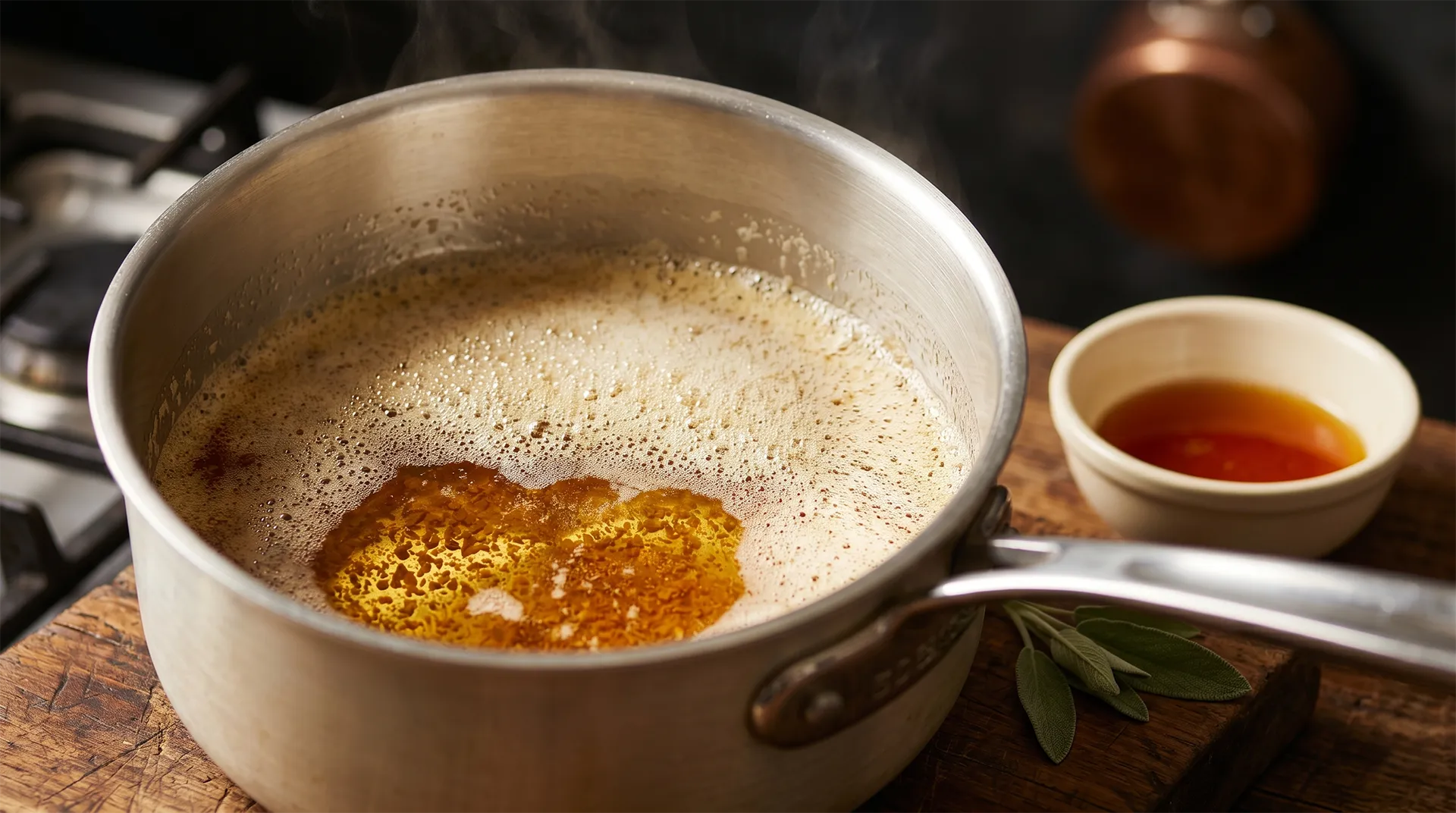
Melt the Butter: Place butter pieces in a light-colored saucepan over medium heat. Stir or swirl occasionally as the butter melts.
Sensory Cue: Active sputtering and white foam will develop on the surface — this is water boiling off. Do not be alarmed; do not rush it.
-
Watch the Transition: As the water fully evaporates, the sputtering will subside and the foam will thin. Underneath, you will begin to see the milk solids on the pan floor start to change color.
Sensory Cue: Color moves from pale yellow → golden → amber. The aroma shifts from dairy to distinctly nutty and toasted — faintly reminiscent of hazelnuts.
-
Pull at Amber: The moment the solids reach a deep amber and the aroma peaks, immediately pour the butter into your heat-proof abort vessel. The residual heat of the pan will continue cooking the solids for several seconds after removal from heat.
Critical: Do not wait for the color you want to see in the pan. Pull 5–10 seconds before it looks done.
Sensory Cue: The finished butter should be clear and amber with dark golden solids suspended throughout. It should smell nutty, caramel-like, with no acrid or burned notes.
-
Strain or Keep Solids: For most applications, keep the solids — they carry the flavor. For elegant plated applications or clear compound butters, strain through a fine-mesh sieve.
Phase 2A: Fresh / Liquid Applications.
Use the butter warm, immediately after making, or gently rewarmed over low heat.
| Variant | Key Addition | Timing | Primary Applications |
|---|---|---|---|
| Classic | None | — | Pan-seared fish, fresh pasta, fried eggs, steamed vegetables |
| Lemon | Add juice off heat; swirl in zest at plating | Off heat | Halibut, sole, asparagus, broccolini, gnocchi |
| Sage | Drop dried leaves into hot butter 60 sec before pulling | In pan | Gnocchi, butternut squash, pork chops, ravioli |
| Caper | Add rinsed, dried capers to hot butter in pan; fry 30–45 sec until they begin to pop and color, then pour off | In pan | Skate wing, roasted cauliflower, chicken piccata base |
| Miso | Whisk miso into finished warm butter off heat | Off heat | Seared scallops, roasted root vegetables, ramen finishing — can also be chilled as compound form (see Phase 2B) |
Phase 2B: Chilled / Solidified Applications.
Allow finished butter to cool to room temperature, then refrigerate until fully opaque and firm. Use as you would compound butter.
| Variant | Key Addition | Method | Primary Applications |
|---|---|---|---|
| Classic | None | Chill in mold or roll in plastic wrap | Slice-and-finish steaks, corn, roasted carrots |
| Spice-Bloomed | Add Aleppo or red pepper flakes immediately off heat; stir to bloom | Chill in mold | Baking, cookies (ref: 09-02), finishing chili |
| Lemon-Herb | Add lemon zest + chopped thyme or tarragon; stir off heat | Roll in plastic wrap | Fish en papillote, grilled chicken, roasted broccolini |
| Miso Compound | Whisk miso into cooled but still liquid butter; chill (liquid-state method in Phase 2A) | Chill in mold | Steaks, mushrooms, corn, ramen finishing pat |
| Citrus & Zest | Add orange or lemon zest + pinch of salt off heat | Roll in plastic wrap | Crêpes, pound cake, tart shells, madeleines |
Chef’s Notes
- The Danger Window: The margin between beurre noisette (hazelnut) and beurre noir (black butter, acrid, unusable) is approximately 15–20 seconds at medium heat. Your abort vessel is not optional. Have it in hand before you start.
- Pan Selection: Light-colored stainless or enameled interiors are mandatory for accuracy. Non-stick pans are acceptable but the dark surface delays your ability to read the color of the solids accurately. Never use a black carbon steel or cast iron pan for this technique.
- Butter Fat Content & Quality: This is where your raw material choice has a direct, measurable impact on flavor.
- Yield Reality: Expect 170–180 g of finished butter from 226 g raw. The loss is almost entirely water. For recipes requiring a precise weight of noisette, always start with more butter than you think you need.
- Storage: Fresh beurre noisette keeps refrigerated in an airtight container for up to 2 weeks. Frozen, it holds for 3 months. The flavor mellows slightly over time — use the freshest batch for delicate applications like fish.
- Clarified vs. Noisette: Clarified butter removes the milk solids before they can brown, producing a clean, high-smoke-point fat with a neutral flavor. Beurre noisette keeps and toasts those solids. They are different tools for different jobs — do not substitute one for the other.
Glossary
- Beurre Noisette: “Hazelnut butter.” Whole butter cooked until the water evaporates and the milk solids toast to a deep amber, producing a nutty, caramel-scented fat.
- Beurre Noir: “Black butter.” Butter cooked beyond noisette to a very dark brown; used in specific classical preparations (skate meunière) but easily becomes acrid and unusable.
- Maillard Reaction: A chemical reaction between amino acids and sugars under heat, producing hundreds of flavor compounds responsible for browning, toasting, and roasting aromas.
- Abort Vessel: A heat-proof bowl used to immediately halt cooking by receiving the finished butter away from the heat source.
- Compound Butter (Beurre Composé): Softened or melted butter blended with flavorings, then re-solidified for use as a finishing element.
- Butterfat: The fat component of butter, expressed as a percentage. Higher butterfat means less water, richer flavor, and faster browning.