Chapter 10 · Stocks, Sauces & Condiments
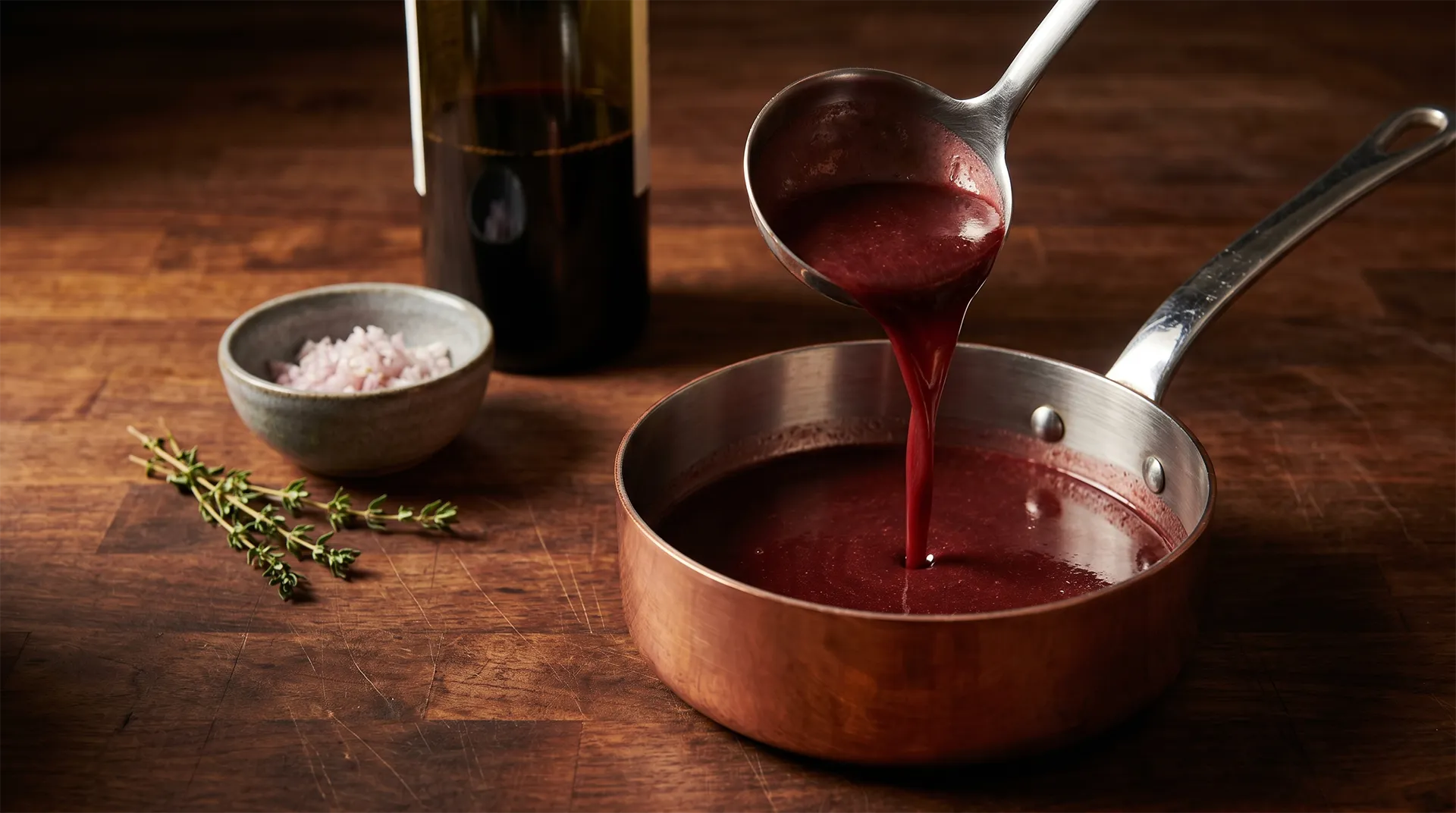
Classic Beurre Rouge
A velvety, deeply aromatic red wine butter emulsion with notes of earth and dark fruit.
Yield: ~240 ml (1 cup) | Prep: 15 min | Cook: 25 min | Total: ~40 min
Headnote
Unlike the flour-thickened sauces of the mother sauce family (like Béchamel), Beurre Rouge relies entirely on the temporary mechanical emulsion of water (wine reduction) and fat (butter). The result is a sauce with a luxurious, glossy mouthfeel that coats the palate without feeling heavy. Teaching Idea: The Temperature Threshold. This sauce is thermodynamically unstable. If the temperature exceeds 130°F (54°C) once the butter is added, the emulsion will break (separate into oil and solids). You must rely on residual heat during the final mounting phase.
Ingredients
The Reduction Base
- 400 g (1 ¾ cups) Full-Bodied Red Wine (Cabernet or Merlot)
- 50 g (1.7 fl oz) Ruby Port
- 5 g (1 tsp) Tomato Paste
- 4 g (1 tsp) Granulated Sugar
The Aromatics
- 100 g (¾ cup) Shallots, finely diced
- 45 g (3 medium) Button Mushrooms, finely diced
- 15 g (1 tbsp) Carrot, finely diced
- 1 Garlic Clove, bruised
- 2 Sprigs Fresh Thyme
- 2 Stems Parsley (leaves reserved for garnish)
- 1 Fresh Bay Leaf
- 1 g (½ tsp) Black Peppercorns
- 1 g (½ tsp) Juniper Berries, bruised
The Emulsion
- 150 g (10.5 tbsp) Unsalted Butter, cubed and ice-cold
- Diamond Crystal Kosher Salt, to taste
- Black Pepper, freshly ground, to taste
Mise en Place (Action Checklist)
- Chill the Fat: Cut the butter into small 1 cm cubes and return them to the refrigerator immediately. They must be ice-cold when they hit the pan.
- Prep the Aromatics: Thinly mince the shallots and mushrooms to maximize surface area for extraction.
- Bruise the Spices: Gently crush the juniper berries and garlic clove with the side of a knife to release oils.
- Clarify the Workspace: Set up a fine-mesh sieve (chinois) over a clean saucepan before you begin reducing.
Method
Phase 1: The Extraction.
Combine the Red Wine, Port, Tomato Paste, and Sugar in a large sauté pan or skillet. Whisk to dissolve the paste. Add all ingredients from the Aromatics group (shallots, mushrooms, carrots, herbs, spices). Bring the mixture to a boil over high heat. Once boiling, reduce heat to medium-high and simmer briskly.
Why: Using a wide skillet instead of a pot increases surface area, speeding up evaporation and concentrating the flavor compounds.
Phase 2: The Glace.
Reduce the liquid by half. Pour the mixture through a fine-mesh sieve into a smaller saucepan. Press hard on the solids with the back of a ladle or spoon to extract every drop of the flavored liquid. Discard the solids. Return the strained liquid to the stove over medium heat. Continue to reduce until you have approximately 60 ml (4 tablespoons) of liquid remaining.
Sensory Cue: The liquid should look syrupy and bubble slowly (similar to warm honey). If you tilt the pan, it should coat the bottom lazily.
Phase 3: The Monte (Emulsification).
Turn the heat to LOW (or remove from heat entirely if your burner runs hot). Begin adding the Cold Butter, one cube at a time, whisking constantly and vigorously. Do not add the next cube until the previous one has fully emulsified (disappeared) into the sauce.
Why: The cold butter regulates the temperature of the sauce, keeping it below the “breaking point” while the mechanical action of whisking disperses the fat droplets into the reduction.
Phase 4: Stabilization and Seasoning.
Once all butter is incorporated, the sauce should be opaque, glossy, and thick enough to coat a spoon (nappé). Taste and adjust with salt and pepper. Critical Step: If not serving immediately, hold the sauce in a warm spot (like a double boiler turned off) between 100°F–115°F (38°C–45°C). Do not let it boil.
Chef’s Notes
- Troubleshooting (Broken Sauce): If the sauce splits (looks oily or greasy), the temperature went too high. Fix: Remove from heat immediately. Add 1 tablespoon of ice-cold water and whisk furiously. This cools the mixture and re-aligns the emulsion.
- Wine Choice: Do not use “cooking wine.” Use a wine you would enjoy drinking. The reduction amplifies the flavor profile, so a bitter or cheap wine will result in a bitter sauce.
- Pairing: This is the classic accompaniment for poached fish (Salmon or Turbot) or grilled steak when you want something lighter than a Bearnaise.
Glossary
- Monte au Beurre: “Mount with butter.” The technique of finishing a sauce by whisking in cold butter to add shine, thickness, and flavor.
- Emulsion: A mixture of two liquids that don’t normally mix (like oil and water), stabilized by agitation or a bonding agent.
- Nappé: The consistency of a sauce that is thick enough to coat the back of a spoon and hold a line when drawn through with a finger.