Chapter 9 · The Pâtissier
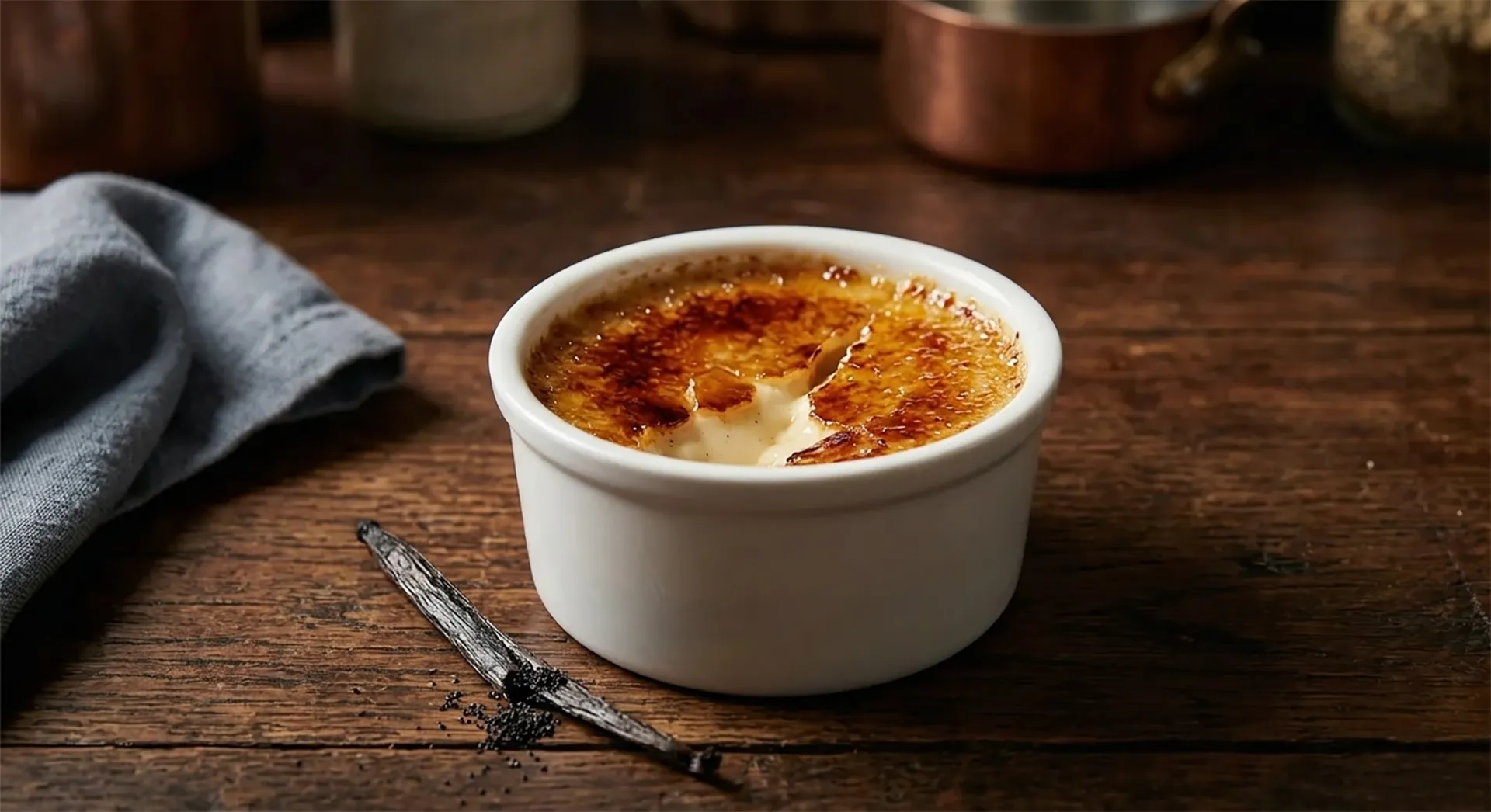
Crème Brûlée
The definitive classic. Silky vanilla custard beneath a shatteringly thick turbinado crust — built on three precision points: a proper temper, a bain-marie thermal buffer, and a wobble-test pull.
Yield: 4 ramekins (180 ml each) | Prep: 20 min | Inactive: 2 hr | Cook: 40 min | Total: ~3 hr
Headnote
Crème Brûlée is four ingredients and one technique — which means there is nowhere to hide. The custard’s texture lives or dies on three decisions: how carefully you temper the yolks, how faithfully you respect the bain-marie, and when you pull the ramekins from the oven. Get those right and the result is a trembling, glassy custard under a crust that cracks like porcelain. Teaching Idea: The Bain-Marie as Thermal Buffer. Water boils at 212°F/100°C and cannot exceed that temperature at standard pressure. By baking the custard in a water bath, you cap the thermal environment well below the oven temperature, preventing the egg proteins at the edges from overcooking before the center sets — a physics trick, not a precaution.
Ingredients
The Custard
- 500 ml (2 cups) heavy cream
- 5 large egg yolks (approximately 90 g)
- 100 g (½ cup) granulated sugar
- 1 vanilla bean, split and scraped
- 2.5 ml (½ tsp) pure vanilla extract
- 1 g (¼ tsp) Diamond Crystal kosher salt
The Crust
- 24 g (4 tsp) turbinado sugar, divided (6 g per ramekin)
Mise en Place
- Split and scrape the vanilla bean: Run a paring knife down the length of the pod and scrape the seeds with the back of the blade. Reserve both seeds and pod.
- Separate the eggs: Separate yolks into a medium heat-proof bowl. Discard whites or reserve for another use.
- Preheat oven: 325°F/163°C.
- Prepare the bain-marie: Set four 180 ml ramekins in a deep roasting pan. Have a kettle of hot water ready.
- Chill plan: Clear refrigerator space for the roasting pan to chill post-bake.
Method
Phase 1 — Infuse the Cream
Combine the heavy cream, vanilla bean seeds, vanilla pod, and salt in a medium saucepan. Heat over medium until the cream just begins to steam and small bubbles form at the edges — approximately 170°F/77°C. Do not boil.
Remove from heat and allow to steep for 10 minutes. Remove and discard the vanilla pod.
Why: Steeping extracts the full aromatic compound profile from the bean. Boiling drives off volatile top notes and denatures the cream proteins unnecessarily.
Phase 2 — Temper the Yolks
Whisk the egg yolks and granulated sugar together until the mixture is pale yellow and slightly thickened — approximately 60–90 seconds. The mixture should fall from the whisk in a slow, continuous ribbon.
With the whisk moving constantly, add the hot cream in a slow, thin stream — begin with just a tablespoon, then gradually increase the flow. Once half the cream is incorporated, you can add the remainder more freely.
Add the vanilla extract and whisk briefly to combine.
Sensory Cue: The finished custard base should be smooth, pale, and homogenous — no streaks, no visible coagulation. If you see any white threads, you moved too fast. Strain through a fine-mesh sieve before proceeding.
Why: Tempering is a controlled protein introduction. Cold yolk proteins shock on contact with hot fat and seize — scrambled eggs in your brûlée. The slow stream raises the yolk temperature gradually, allowing the proteins to relax into the emulsion rather than contract.
Phase 3 — Fill and Bake
Skim any surface foam from the custard base with a spoon. Divide evenly among the four ramekins — approximately 150–155 ml each after skimming.
Place the roasting pan in the oven. Pour hot water into the pan until it reaches halfway up the sides of the ramekins. Cover the pan loosely with aluminum foil.
Bake at 325°F/163°C for 35–45 minutes.
Wobble Test: At 35 minutes, gently nudge the pan. The edges should be fully set — no movement. The center 3–4 cm should jiggle in one cohesive motion, like a soft gel. If the entire surface sloshes as liquid, return for 5-minute increments. If the center is fully rigid, they are overbaked.
Why: Carryover cooking continues in the ramekin after removal from the oven. Pulling at the wobble — not at full set — is what produces a trembling, silky center rather than a firm, rubbery one.
Phase 4 — Chill
Remove ramekins from the water bath immediately. Cool on a wire rack for 30 minutes, then refrigerate uncovered for a minimum of 2 hours. The custard must be fully cold and set before torching.
Sensory Cue: The surface should feel dry and taut to the touch — not tacky. Any condensation on the surface must be blotted gently with a paper towel before applying sugar.
Phase 5 — Brûlée the Crust
Sprinkle 6 g turbinado sugar evenly over each custard in a thin, uniform layer. Tilt and tap the ramekin to distribute — do not press.
Pass 1 — Melt: Hold the torch 10–12 cm from the surface. Move in slow, tight circles until all crystals are fully melted and the surface is translucent and glossy. Rest 20 seconds.
Pass 2 — Caramelize: Return the torch and continue in circular passes until the surface is deep amber — not black. The crust should be uniformly caramelized with no pale patches.
Rest 2–3 minutes before serving. The crust will harden as it cools.
Why: The two-pass method is specific to turbinado’s large crystal structure. Single-pass torching produces uneven caramelization — scorched peaks over unmelted valleys. The 20-second rest between passes allows the molten sugar to stabilize and level before the second heat application drives color development.
Chef’s Notes
Yolk Ratio — What Changes:
| Yolks per 500 ml cream | Effect |
|---|---|
| 4 yolks | Lighter set, more delicate — higher risk of weeping, shorter stability window |
| 5 yolks (this recipe) | Classic balance — silky, stable, proper tremble |
| 6 yolks | Richer, denser, slightly egg-forward — more forgiving bake window |
Crust Sugar Options: The sugar choice directly affects crack profile and caramelization behavior.
| Sugar | Melt behavior | Crack | Risk |
|---|---|---|---|
| Superfine/caster | Fast, even | Thin, glassy, clean snap | Burns fast — narrow torch window |
| Granulated | Moderate | Medium thickness, reliable | Occasional unmelted hot spots |
| Turbinado (this recipe) | Slow, uneven | Thick, amber, textured crack | Requires two-pass technique |
Vanilla Bean Quality: This recipe has nowhere to hide weak aromatics. Use a plump, pliable bean — if it snaps rather than bends, the moisture and volatile compounds are gone. Supplement with the vanilla extract as written; it is not optional.
Cultured Cream Variant: Substituting 20–30% of the heavy cream with crème fraîche adds a faint lactic tang that layers interestingly against the vanilla. Note: the acidity accelerates egg protein coagulation — reduce bake temp to 310°F/154°C and watch the wobble test closely. Not tested at full replacement.
No Torch? Lighter Workaround: A butane kitchen lighter works — the flame is narrower, so use 3–4 tight circular passes per phase rather than 2 broad ones. Expect slightly less even caramelization but fully functional results.
Finishing Options:
Serve the brûlée as-is, or consider:
-
Fleur de sel — a pinch of hand-harvested French sea salt applied immediately after torching. The large, irregular crystals don’t dissolve into the crust — they sit on top and deliver sharp bursts of salinity against the sweet caramel. One of the simplest upgrades in the book.
-
Dutch-process cocoa — dust a thin veil over the turbinado before torching. The cocoa blooms under heat and adds a bitter counterpoint to the caramel crust. Apply sparingly — excess fat from the cocoa can inhibit even caramelization.
-
Fresh raspberries — place after torching, never before. Acidity cuts the richness cleanly.
Glossary
- Bain-marie: A hot water bath used to moderate oven heat around a delicate preparation, capping the thermal environment at 212°F/100°C regardless of oven temperature.
- Tempering: The gradual introduction of a hot liquid into cold egg yolks to raise their temperature slowly, preventing protein coagulation (scrambling).
- Carryover cooking: The continuation of cooking in food after removal from a heat source, driven by residual thermal energy stored in the vessel and the food itself.
- Wobble test: A visual doneness check in which the ramekin is gently nudged — a properly set custard shows a cohesive jiggle at the center, not liquid movement.
- Turbinado: A minimally refined raw sugar retaining residual molasses. Its large crystal structure produces a thicker, more textured brûlée crust than refined sugars.
- Denaturation: The structural unfolding of proteins under heat, acid, or mechanical stress — in custard cookery, the controlled denaturation of egg yolk proteins produces the set texture.
- Fleur de sel: Hand-harvested French sea salt with large, irregular crystals and a clean mineral finish. Used as a finishing salt, not a cooking salt.
- Dutch-process cocoa: Cocoa powder treated with an alkalizing agent to neutralize acidity, producing a darker color and mellower, less bitter flavor than natural cocoa.