Chapter 9 · The Pâtissier
Gooey Butter Cake
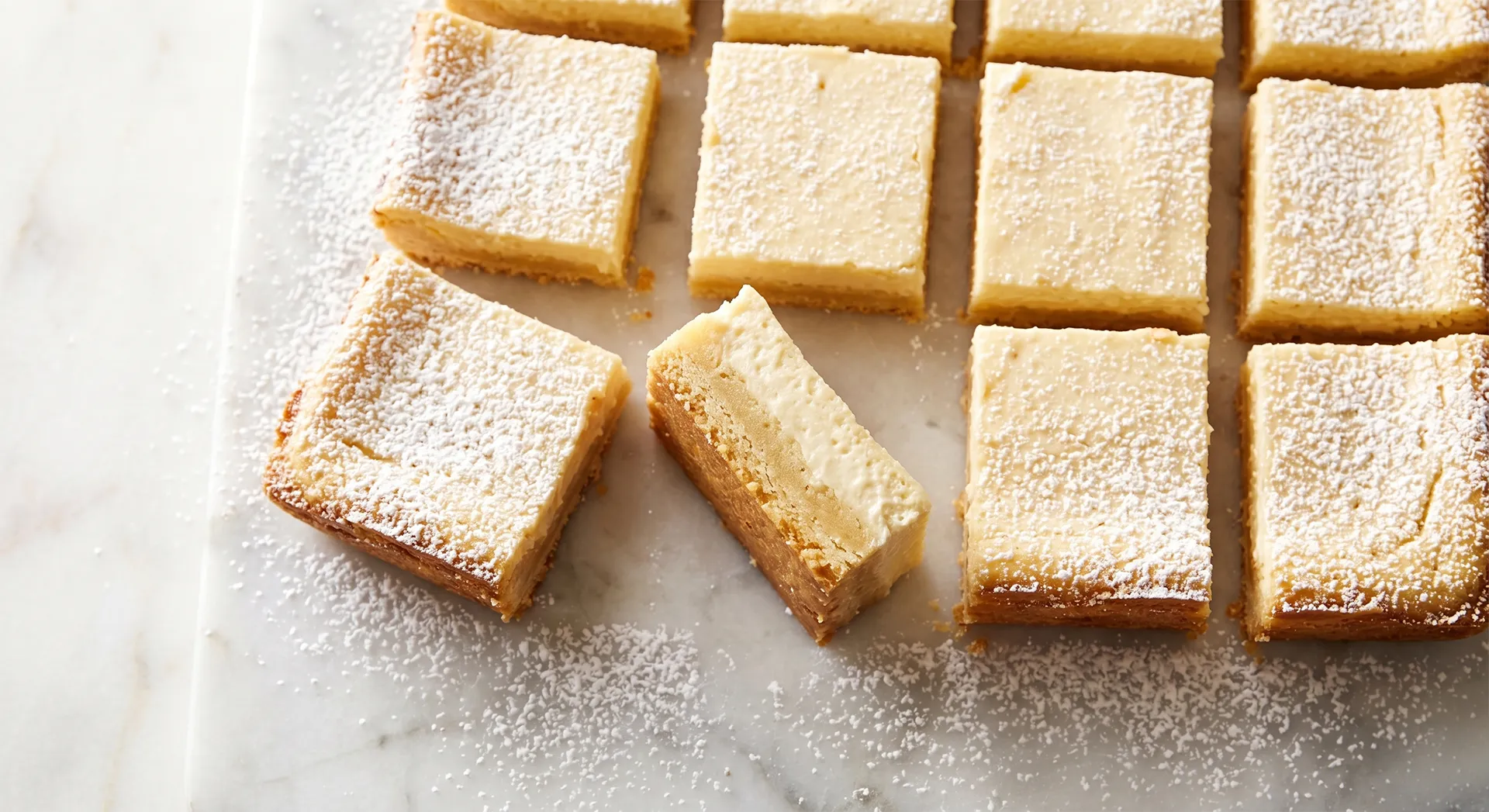
A St. Louis original — dense shortbread base topped with a cream cheese layer that bakes into something between a custard and a cake, golden on top and yielding through the center.
Yield: 24 bars | Prep: 20 min | Inactive: 1 hr (cooling) | Cook: 30–35 min | Total: ~2 hr
Headnote
Gooey Butter Cake is St. Louis’s most iconic baked good — two layers, one pan, no frosting required. The base is a soft, butter-enriched dough that bakes firm; the topping is cream cheese beaten with powdered sugar and eggs into a pourable custard that sets at the edges and stays yielding in the center. The defining characteristic is that yielding center — if it’s fully set all the way through, it’s overbaked. Teaching Idea: Sugar as a Set Inhibitor. The topping’s extraordinary powdered sugar load isn’t just sweetness. At this concentration, dissolved sugar molecules crowd out the egg protein networks that would otherwise coagulate and firm. This is why the topping stays creamy even when baked through — the sugar interference prevents the eggs from forming a fully rigid gel, locking in the gooey texture the cake is named for.
Ingredients
The Cake Base
- 190 g (1½ cups) all-purpose flour
- 4 g (1 tsp) baking powder
- 1.5 g (¼ tsp) Diamond Crystal kosher salt
- 100 g (½ cup) granulated sugar
- 113 g (½ cup / 1 stick) salted butter, softened (room temperature)
- 10 ml (2 tsp) pure vanilla extract
- 1.25 ml (¼ tsp) almond extract (optional)
- 1 large egg (approximately 50 g), room temperature
The Cream Cheese Topping
- 226 g (8 oz) full-fat cream cheese, room temperature
- 3 large eggs (approximately 150 g), room temperature
- 454 g (approximately 3¾ cups) powdered sugar, sifted
Mise en Place
- Preheat oven to 350°F/177°C; position rack in the center.
- Prepare a 9×13-inch baking pan: spray with nonstick spray and line with parchment, leaving a 2-inch overhang on the long sides for lifting.
- Bring butter, cream cheese, and all four eggs to room temperature (approximately 70°F/21°C) — about 1 hour out of the refrigerator.
- Whisk together the flour, baking powder, and salt in a medium bowl. Set aside.
- Sift the powdered sugar into a separate bowl. Set aside.
Method
Stage 1 — Build the Cake Base
In the bowl of a stand mixer fitted with the paddle attachment, combine the softened butter, granulated sugar, vanilla extract, and almond extract (if using). Beat on medium-high speed for 2–3 minutes until pale and fluffy.
Why: Creaming the butter and sugar incorporates air that helps the base bake into a firm, structured layer capable of supporting the heavy cream cheese topping without compressing.
Add the egg and beat for 1 minute until fully incorporated. The mixture should look smooth, cohesive, and slightly glossy.
Reduce speed to low and add the flour mixture in two additions, mixing until just combined — stop when no dry streaks remain. The dough will be soft and slightly tacky.
Sensory cue: The dough should pull away from the bowl sides cleanly and hold its shape when pressed. If it’s wet and spreading, the butter was too warm.
Turn the dough into the prepared pan and press it into an even layer using damp fingertips or the flat base of a measuring cup. Work into the corners — the layer should be uniform and approximately ½ inch thick.
Stage 2 — Build the Cream Cheese Topping
Wash and dry the mixer bowl thoroughly. Add the room-temperature cream cheese and beat on medium-high speed for 2 minutes until completely smooth and fluffy — no lumps.
Add the three eggs one at a time, beating for 30 seconds between each addition.
Sensory cue: After all three eggs are incorporated, the mixture should be smooth and pourable with a glossy sheen. If it looks curdled, the cream cheese was too cold — warm the bowl briefly over a water bath and continue mixing.
Reduce speed to low. Add the sifted powdered sugar in three additions, mixing until smooth between each. Scrape the bowl and paddle with a rubber spatula and mix for a final 15 seconds.
Sensory cue: The finished topping should be thick, silky, and pourable — similar to a thick cake batter, not a stiff frosting.
Stage 3 — Assemble and Bake
Pour the cream cheese topping over the pressed dough base and spread evenly to the edges with an offset spatula.
Bake at 350°F/177°C for 30–35 minutes on the center rack until the top is uniformly golden brown and the edges are set. The center should still register a slight jiggle when the pan is nudged — firm Jell-O, not liquid.
Critical: Do not bake until the center is completely firm. A fully set center means the cake is overbaked and will lose its defining texture as it cools.
Sensory cue: The surface should be matte and golden — not shiny or wet. The edges will have pulled slightly from the parchment. The jiggle zone should cover the center third of the pan only.
Stage 4 — Cool and Cut
Cool in the pan on a wire rack at room temperature for a minimum of 1 hour. For cleanest cuts and optimal texture, refrigerate for 2 hours or overnight before cutting.
Use the parchment overhang to lift the cake from the pan. Transfer to a cutting board and cut into 24 squares (4 cuts along the short side, 6 along the long side). Wipe the knife clean between cuts.
Sensory cue: Cold bars cut cleanly with a sharp knife. Room-temperature bars are softer and more spreadable — both are correct.
Dust generously with additional powdered sugar before serving.
Chef’s Notes
- Cold vs. room temperature: Cold bars are firmer with more distinct layers; room-temperature bars are softer and almost molten at the center. Both are traditional — serve according to preference.
- Make-ahead: Refrigerate, covered, for up to 5 days. Freeze in a single layer for up to 1 month — thaw overnight in the refrigerator.
- Almond extract: Optional but traditional in many St. Louis versions. Adds a subtle marzipan note that plays against the cream cheese tang. If uncertain, start with ⅛ tsp.
- Brown Butter Variation: Brown the butter, chill it back to solid, then use in place of the softened butter. Adds a toffee complexity to the base without changing structure.
Glossary
- Creaming: The process of beating softened fat with sugar at medium-high speed to incorporate air, creating a light, pale mixture that provides structure and lift in baked goods.
- Paddle attachment: The flat, leaf-shaped stand mixer attachment used for creaming, beating dense batters, and mixing — as opposed to the whisk (aeration) or dough hook (kneading).
- Set inhibitor: Any dissolved solute — sugar, salt, alcohol — that interferes with protein or starch network formation during cooking or baking, keeping a mixture fluid or soft at temperatures that would otherwise cause it to firm.
- Offset spatula: A long-bladed spatula with a bend near the handle, used for spreading batters and fillings into even layers in baking pans.