Chapter 7 · The Butcher
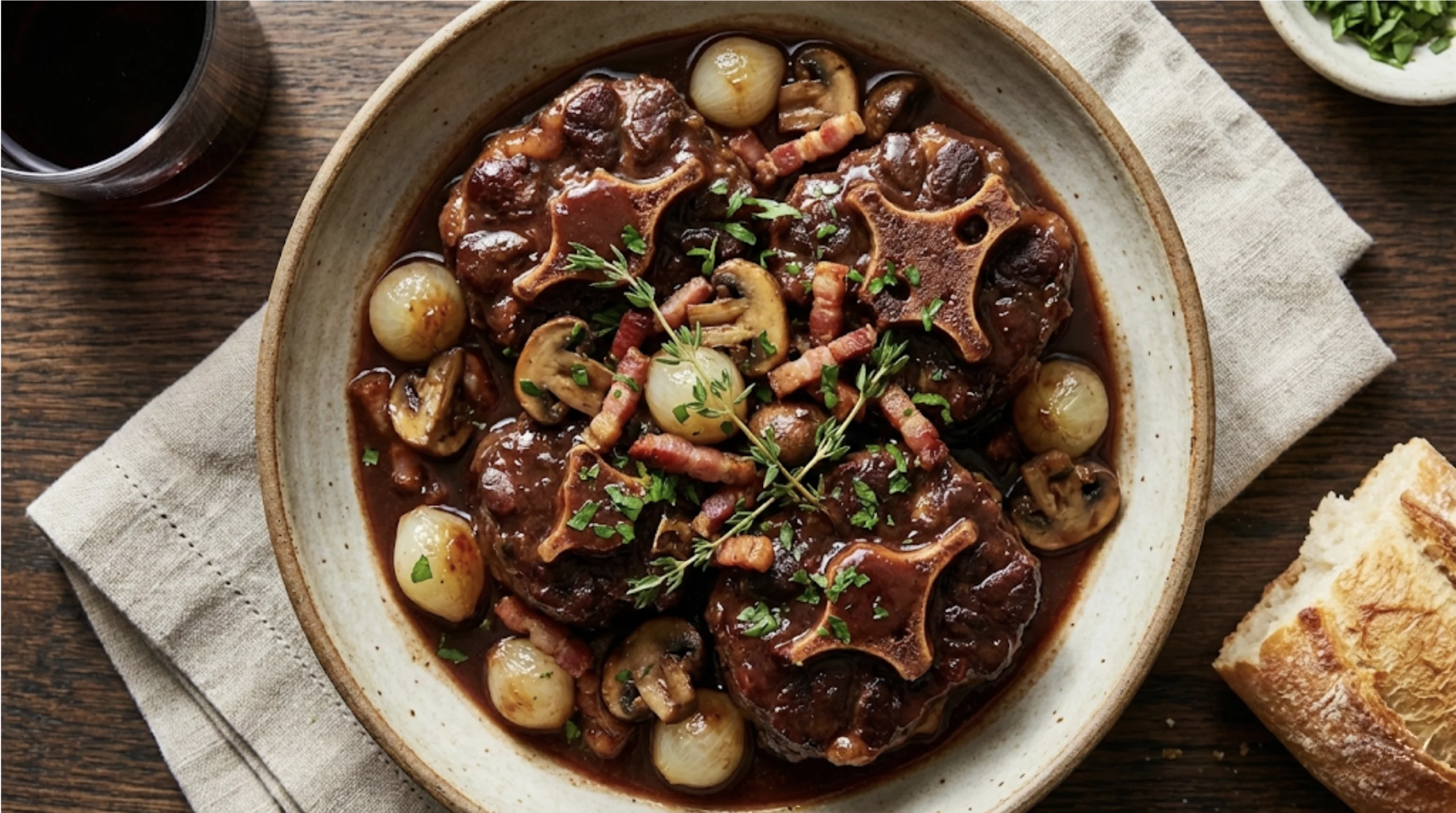
Oxtail Bourguignon
The Collagen-Rich Braise
Yield: 4–6 servings | Prep: 45 min | Cook: 3.5–4 hr | Total: ~4.5–5 hr
Headnote
Oxtail is the ultimate cut for braising due to its high ratio of bone and connective tissue to meat. As the collagen breaks down over a long, slow cook, it enriches the sauce with natural gelatin, providing a silky mouthfeel without the need for excessive starch thickeners. We cook the garniture (mushrooms, onions, bacon) separately and add them at the end to preserve their distinct textures.
Teaching Idea: Collagen Hydrolysis. Tough connective tissue (collagen) begins to dissolve into soft gelatin at roughly 160°F/71°C, but it requires time. Maintaining a sub-boiling temperature (braising) allows this conversion to happen without drying out the muscle fibers.
Ingredients
The Meat
- 2000 g (4.5 lbs) Beef Oxtails, disjointed into segments
- 12 g (1 tbsp) Diamond Crystal Kosher Salt (for seasoning meat)
- Black Pepper, freshly ground
The Braising Base
- 150 g (1 cup) Bacon Lardons (Thick-cut bacon sliced into strips)
- 225 g (1 large) Yellow Onion, large dice
- 150 g (2 medium) Carrots, peeled and roll-cut (oblique)
- 30 g (2 tbsp) Tomato Paste
- 30 g (3 tbsp) All-Purpose Flour
- 750 ml (1 bottle) Dry Red Wine (Pinot Noir or Cotes du Rhône)
- 500 ml (2 cups) Brown Beef Stock or Roasted Chicken Stock
- 4 sprigs Fresh Thyme
- 2 sprigs Fresh Parsley
- 1 leaf Bay Leaf
The Grand Garniture (Finish)
- 200 g (7 oz) Pearl Onions, peeled
- 225 g (8 oz) Cremini Mushrooms, quartered
- 30 g (2 tbsp) Unsalted Butter
- 15 g (1 tbsp) Sugar (for glazing onions)
Mise en Place (Action Checklist)
- Temper the meat: Remove oxtails from the fridge 45 minutes prior to cooking and pat thoroughly dry with paper towels.
- Preheat oven: Set to 300°F/150°C, rack in the lower third.
- Cut the lardons: Slice the slab bacon into ¼-inch batons (lardons). They will be rendered in Phase 1 of the Method.
- Prep the Veg: Cut carrots and onions into large mirepoix (1-inch pieces).
- Stage the stock: Ensure your beef or chicken stock is at room temperature.
Method
Phase 1: Render and Sear. In a large Dutch oven over medium heat, cook the bacon lardons until the fat renders and the bits are crisp. Remove with a slotted spoon and reserve. Increase heat to medium-high. Season the oxtails generously with salt and pepper. Working in batches, sear the oxtails in the hot bacon fat, ensuring they are not touching. Why: Crowding the pan lowers the surface temperature and creates steam, inhibiting the Maillard reaction (browning). We need deep brown crust for flavor. Transfer seared meat to a tray.
Phase 2: Building the Fond. Discard all but 30 ml (2 tbsp) of fat from the pot. Add the diced yellow onions and carrots. Sauté for 5–7 minutes until the onions are translucent and beginning to brown. Add the tomato paste and stir constantly for 2 minutes. Sensory Cue: The paste should darken from bright red to a brick/rust color (pincé). This caramelizes the sugars in the tomato and removes acidity. Sprinkle the flour over the vegetables and stir for 1 minute to cook out the raw flour taste.
Phase 3: Deglaze and Braise Pour in roughly 250 ml (1 cup) of the red wine. Scrape the bottom of the pot with a wooden spoon to release the fond (browned bits). Add the remaining wine, stock, thyme, parsley, bay leaf, and the seared oxtails (plus any resting juices). Bring to a simmer on the stove, cover with a heavy lid, and transfer to the preheated oven (300°F/150°C). Braise for 3 to 3.5 hours. Check: The meat is done when it pulls away from the bone with zero resistance but has not completely fallen apart into shreds.
Phase 4: The Separate Garnish. (The braise needs no attention for 3 hours — use this time for the garniture.) Prepare the garniture. Mushrooms: Sauté mushrooms in half the butter over high heat until golden brown. Season with salt after they are brown to prevent steaming. Set aside. Pearl Onions: Place peeled onions in a small skillet with the remaining butter, sugar, and enough water to come halfway up the onions. Simmer until water evaporates and onions are glazed in the butter-sugar emulsion. Set aside. Why: Cooking these components separately ensures the mushrooms aren’t rubbery and the onions aren’t mushy, a common flaw in “dump-and-cook” stew recipes.
Phase 5: Refinement and Service. Remove the pot from the oven. Carefully transfer the oxtails to a clean serving vessel. Strain the sauce through a fine-mesh sieve into a clean saucepan, pressing on the cooked mirepoix to extract flavor. Discard the spent vegetables. Simmer the strained sauce over medium heat. Skim off excess fat rising to the top. Reduce until the sauce coats the back of a spoon (nappe). Add the cooked bacon, mushrooms, and glazed pearl onions to the sauce to warm through. Pour the enriched sauce and garnish over the oxtails. Serve immediately.
Chef’s Notes
- The Next Day: Like all braises, this dish is significantly better the next day after the flavors have had time to meld and diffusion has equalized the seasoning.
- The Bone: Remind guests that oxtail is a bone-in cut. Provide a vessel for discarded bones.
- Wine Choice: Do not use “cooking wine.” Use a drinkable bottle. If you wouldn’t drink it, don’t put it in your food.
Glossary
- Collagen: A protein found in connective tissues that, when heated slowly, undergoes hydrolysis, breaking down into gelatin, contributing to a rich, velvety sauce.
- Fond: The concentrated flavor developed from the browned bits (Maillard reaction products) at the bottom of a pot during sautéing, essential for building depth of flavor in a braise.
- Maillard Reaction: A chemical reaction between amino acids and reducing sugars that produces hundreds of flavor and aroma compounds, resulting in browning and complex flavors.
- Nappe: A thickened sauce achieved by reducing the liquid until it coats the back of a spoon, creating a smooth and glossy consistency.
- Pincé: A French culinary term referring to the color change of a sauce or ingredient during cooking, specifically the transformation of tomato paste from red to a darker, brick-colored hue.
- Mirepoix: A classic French culinary technique utilizing a base of diced onions, carrots, and celery, used to build flavor in stocks, sauces, and stews.