Chapter 1 · The Lab
The Architecture of Bread
Concept Definition Bread baking is not an art; it is chemistry engineered by mathematics. To control the outcome, we must control the variables. This folio covers the Breadsmith’s Trinity:
- Baker’s Percentage: The universal language of formulation.
- Hydration: The controller of texture and crumb.
- Preferments: The architects of flavor and keeping quality.
The Science 1. The Mathematics of Ratios In baking, the flour is always 100%. Every other ingredient is a percentage of the flour’s weight. This allows recipes to scale infinitely without breaking the ratio.
- The Formula: (Ingredient Weight / Total Flour Weight) × 100 = %
2. Hydration & Gluten Structure Water acts as the solvent for chemical reactions and the medium for gluten mobility. The ratio of water to flour dictates the “Crumb” (internal structure).
- Low Hydration (50–60%): Tight, dense crumb. The gluten network is stiff and holds shape easily (e.g., Bagels, Pretzels).
- Standard Hydration (60–70%): Flexible crumb with moderate alveoli (holes). Typical for baguettes and rustic whites.
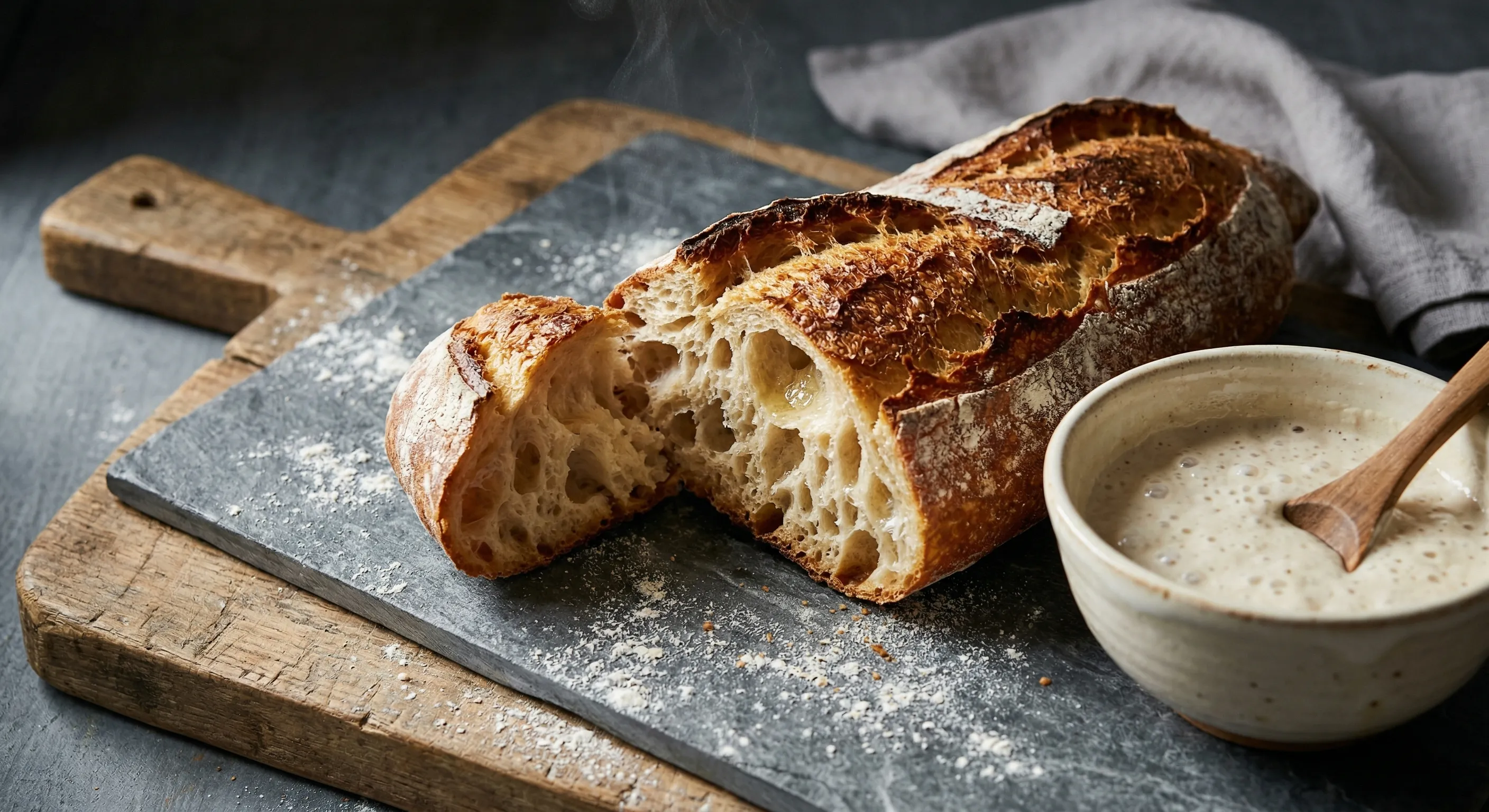
- High Hydration (75–85%+): Open, wild crumb. The excess water creates steam during the “oven spring,” expanding the gluten network violently to create large holes (e.g., Ciabatta, Pan de Cristal).
3. Enzymatic Pre-Digestion (Preferments) A preferment is a portion of dough fermented prior to the final mix. This “head start” allows enzymes (protease and amylase) to break down proteins and starches, creating organic acids (flavor) and improving shelf life.
The Mechanics of Handling (Hydration vs. Energy) Hydration dictates not just the texture, but the technique used to develop gluten.
- Low Hydration (50–65%):
- The Physics: The gluten network is tight and resistant.
- The Technique: Requires Energy (Mechanical Kneading). You must physically push and tear the dough to align the proteins.
- The Visual: Passes the “Windowpane Test” (stretches thin without tearing) when ready.
- High Hydration (70–85%+):
- The Physics: The gluten is loose and fluid.
- The Technique: Requires Time & Folding (Passive Strength). Mechanical kneading often overheats wet doughs. Instead, we use “Coil Folds” or “Stretch & Folds” every 30 minutes. We let time and water align the gluten for us.
- The Visual: Transforms from a “shaggy mess” to a smooth, shiny pillow purely through resting.
Practical Application 1. Selecting Your Preferment Use this guide to choose the right engine for your bread:
| Preferment | Hydration | Characteristics | Best For |
|---|---|---|---|
| Poolish | 100% (Liquid) | Equal parts flour/water. Tiny yeast amount. Creates extensibility (stretch) and sweet, nutty flavors. | Baguettes, Focaccia. |
| Biga | 50–60% (Stiff) | Stiff dough. Adds strength and mild acidity. Reinforces structure in wet doughs. | Ciabatta, Italian breads. |
| Sponge | Var. (Liquid) | Fast fermentation using all the recipe’s yeast. Explosive rise, less complexity. | Enriched doughs (Brioche), Pan breads. |
| Pâte Fermentée | ~65% (Firm) | “Old Dough.” A piece of fully mixed dough (contains salt) saved from a previous batch. | Rustic loaves, daily production. |
2. Controlling Temperature (DDT) Temperature controls the rate of fermentation. To achieve consistency, we calculate the Desired Dough Temperature (DDT), usually 24–26°C (75–78°F). Since we cannot easily change the room or flour temperature, we adjust the Water Temperature.
- The Formula: (DDT × Number of Variables) − (Sum of Known Temps) = Water Temp.
- Variables: usually 3 (Room + Flour + Friction) or 4 (if including preferment).
- Example:
- Target DDT: 25°C.
- Room: 22°C | Flour: 21°C | Friction Factor: ~5°C.
- Calculation: (25 × 3) − (22 + 21 + 5) = 27°C Water Temp.
Practice Exercise: The “Poolish vs. Straight” Test Goal: Observe the impact of preferments on flavor and crust structure using a simple formula.
- The Control (Straight Dough): Mix 500g flour, 350g water, 10g salt, 5g yeast all at once. Ferment 2 hours, bake.
- The Variable (Poolish Dough):
- Night Before: Mix 100g Flour + 100g Water + pinch of yeast. Ferment 12 hours.
- Baking Day: Add remaining ingredients (400g Flour, 250g Water, 10g Salt, remaining yeast).
- Observation: Compare the smell of the raw doughs. The Poolish dough will smell sweeter and more complex (ripe fruit/yogurt) compared to the “flat” yeast smell of the straight dough.
Glossary
- Autolyse: The process of mixing flour and water (no salt, no yeast) and letting it rest for 20–60 minutes. This fully hydrates the starch and relaxes the gluten before mixing begins.
- Baker’s Percentage: A system of measuring ingredients based on the weight of the flour in a recipe, allowing for precise scaling and consistent results.
- DDT (Desired Dough Temperature): The specific target temperature for dough after mixing to ensure predictable fermentation timing, typically maintained through precise control of water temperature and environmental factors.
- Energy (Mechanical Kneading): The force applied during kneading to align gluten proteins, crucial for developing strength and structure in doughs with low hydration.
- Friction Factor: The heat generated by the friction of kneading (by hand or machine), typically raising dough temp by 2–10°C.
- Hydration: The ratio of water to flour in dough, directly influencing the gluten development, crumb structure, and overall texture of the final bread.
- Preferments: Fermented doughs (such as poolish, biga, or sponge) incorporated into a recipe to enhance flavor, improve dough handling, and increase shelf life through enzymatic activity.