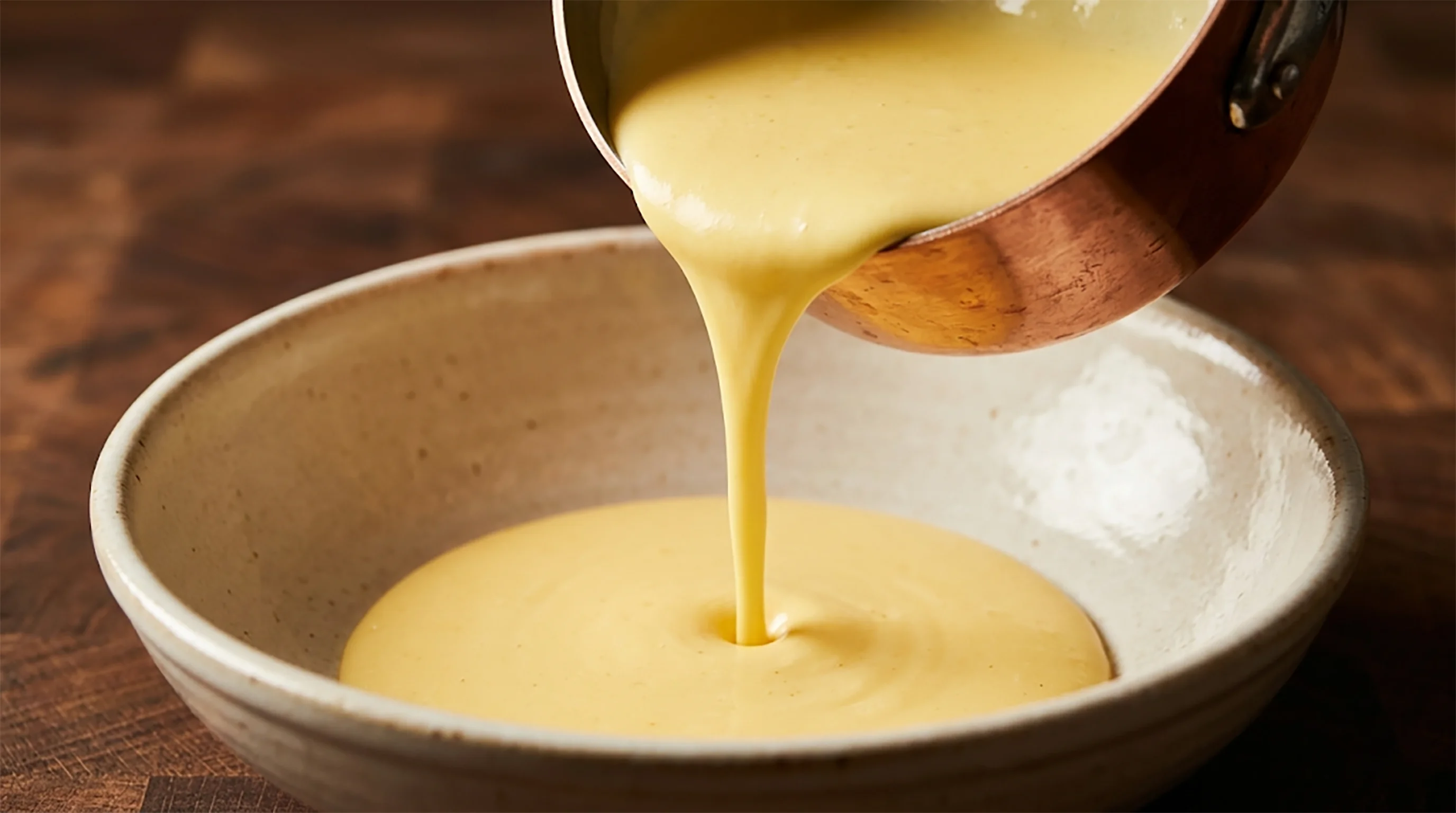
Chapter 1 · The Lab
Emulsions & Hydrocolloids (The Bond)
Technique Emulsification & Bonding Technique Folio emulsionhydrocolloidxanthan gumlecithinvinaigrettemayonnaisehollandaiseshear-thinningfat-waterfermented
Concept Definition In the kitchen, we are constantly trying to mix two things that hate each other: Water and Fat.
- An Emulsion is the forced suspension of tiny droplets of one liquid inside another (e.g., oil droplets floating in vinegar).
- A Hydrocolloid is a substance (usually a gum or starch) that modifies the viscosity of water, acting as a “net” to trap those droplets and prevent them from coalescing (separating).
The Science: Amphiphiles & Nets To keep oil and water together, you need a mediator.
- The Emulsifier (The Surfactant):
- Molecules like Lecithin (found in egg yolks and soy) are “Amphiphilic”—they have a water-loving head and a fat-loving tail.
- The Mechanism: The tail buries itself in the oil droplet, while the head sticks out into the water. This creates a protective shield around the oil, preventing it from merging with other oil droplets.
- The Stabilizer (The Hydrocolloid):
- Xanthan Gum (fermented sugar bacteria) is the modern chef’s secret weapon. Unlike flour (which needs heat) or gelatin (which needs cold), Xanthan works at any temperature.
- The Mechanism: It creates a microscopic lattice structure in the water. This “net” physically blocks oil droplets from moving, locking an emulsion in place for days rather than minutes.
- Shear-Thinning: Xanthan is “pseudo-plastic.” When you shake the bottle (shear force), it becomes liquid/pourable. When it sits on the salad (rest), it instantly thickens, clinging to the lettuce.
Practical Application: The Hierarchy of Bonds
1. The Temporary Emulsion (Vinaigrette)
- The Mix: Oil + Acid + Mechanical Force (Whisking).
- The Result: Breaks within minutes.
- The Fix: Add a “helper” like Dijon mustard (contains mucilage) or honey to slow the separation.
2. The Permanent Emulsion (Mayonnaise/Hollandaise)
- The Mix: Oil + Water + Lecithin (Egg Yolk).
- The Rule: Shear Power. You must break the oil into microscopic droplets.
- The Danger: If you add oil too fast, the “continuous phase” (water/yolk) gets overwhelmed and cannot coat the oil. The sauce “breaks” (looks greasy).
- The Rescue: Start a clean bowl with 1 teaspoon of water. Whisking constantly, slowly pour the broken sauce into the new bowl. The water resets the continuous phase.
3. The Modern Emulsion (Xanthan Gum)
- The Usage: Using Xanthan allows you to make a vinaigrette that never separates, without using egg yolks or heavy cream.
- The Ratio: 0.1% to 0.3% by weight.
- Example: For 500g of dressing, use 0.5g to 1.5g of Xanthan.
- Technique: Do not dump Xanthan into liquid; it will clump (“fish eyes”). You must disperse it in the oil before adding the liquid, or blend it into the vortex of a running blender.
Practice Exercise: The “Xanthan Vinaigrette” Test Goal: Observe the stabilizing power of hydrocolloids.
- Control Group: Whisk 50ml Vinegar and 150ml Oil in a bowl. Stop whisking. Watch it separate in 60 seconds.
- Test Group:
- Place 50ml Vinegar in a blender.
- Weigh 0.2g Xanthan Gum (a tiny pinch).
- Turn blender to low. Dust the Xanthan into the vortex.
- Slowly stream in 150ml Oil.
- The Result: The Test Group will turn into a creamy, opaque dressing that mimics the texture of dairy but contains none. It will remain stable in the fridge for weeks.
Glossary
- Emulsion: The stable mixture of two or more immiscible liquids, typically formed by dispersing one liquid into another through the action of an emulsifier.
- Hydrocolloid: A substance, often a gum or starch, that modifies the viscosity of water by creating a network that entraps dispersed phases.
- Lecithin: An amphiphilic compound, commonly found in egg yolks and soy, utilized as an emulsifier due to its dual affinity for water and fat.
- Xanthan Gum: A fermented polysaccharide used as a hydrocolloid to stabilize emulsions and thicken liquids, functioning effectively across a wide temperature range.
- Shear-Thinning: A property exhibited by certain fluids, such as xanthan gum solutions, where viscosity decreases under shear stress (e.g., shaking or blending).
- Amphiphilic: Describing molecules with both hydrophilic (water-loving) and hydrophobic (fat-loving) characteristics, crucial for emulsification.
- Mucilage: A viscous, gummy substance, such as that found in Dijon mustard, used to temporarily stabilize emulsions by increasing viscosity.